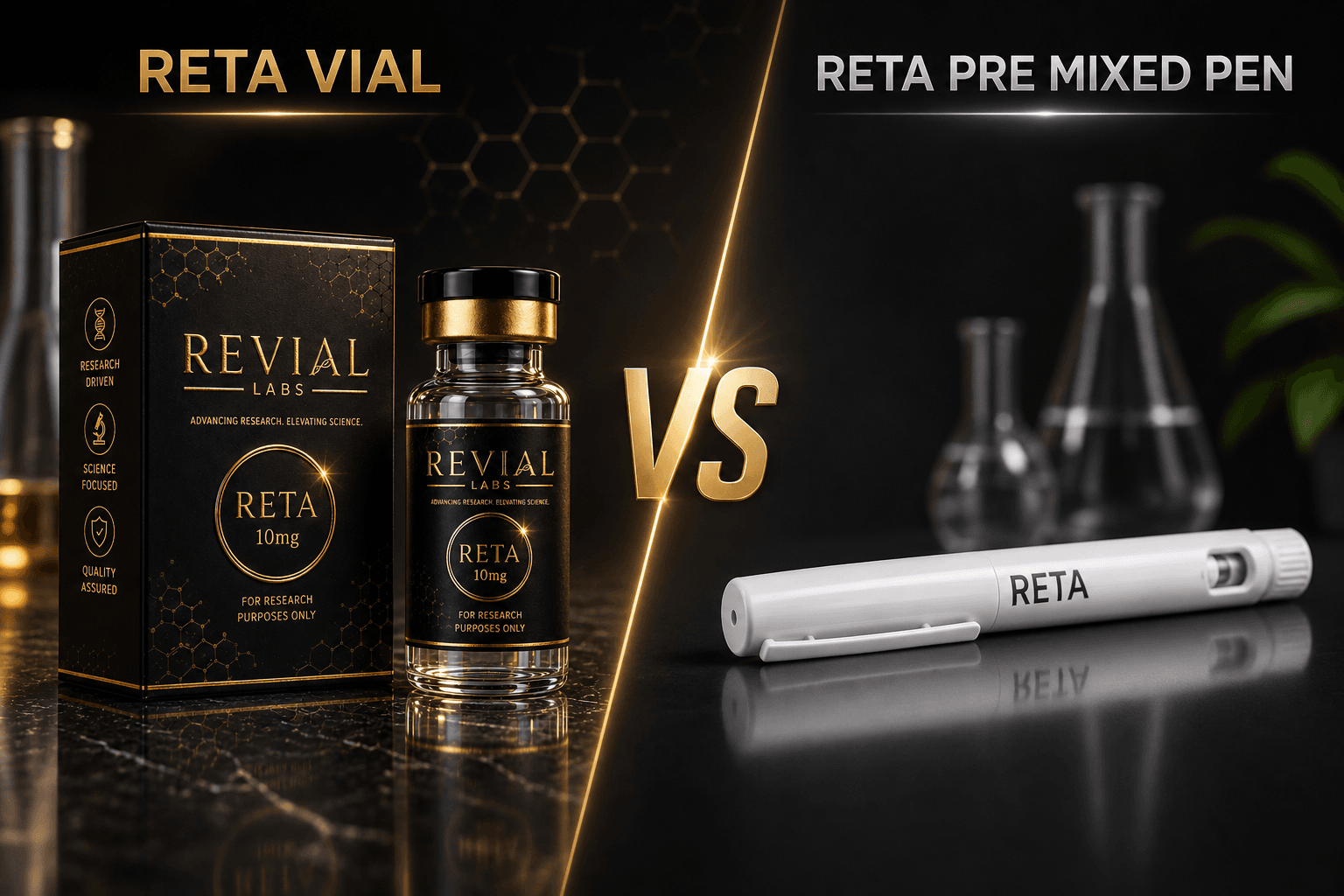
Pre-Mixed Peptide Pens vs Lyophilised Vials: A Stability Comparison
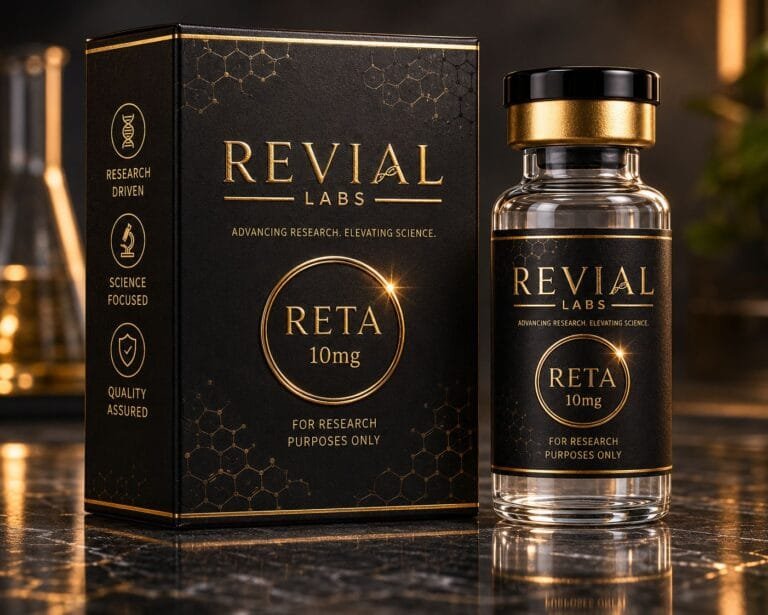
Research peptides arrive in one of two formats: a lyophilised vial containing a dry powder, or a pre-filled multi-dose pen containing a ready-mixed liquid solution. The pen format looks convenient — no reconstitution, no measuring, no separate solvent. But convenience and stability are different things, and the two formats have fundamentally different stability profiles.
A pre-mixed solution of unknown provenance carries risks that a lyophilised powder does not. Understanding why requires a brief look at how peptides degrade in solution, what rigorous pharmaceutical formulation actually involves, and why provenance — knowing exactly where a product came from and how it was handled — matters so much in peptide research.
Two Formats, Two Stability Clocks
The key difference between a lyophilised vial and a pre-mixed pen comes down to one thing: water. Lyophilisation removes water from the formulation, producing a dry powder that is chemically stable at refrigerator temperatures for an extended period. Once water is removed, the dominant degradation pathways are largely suppressed.
In solution, the clock starts the moment the peptide is dissolved. Hydrolysis, oxidation, and aggregation all proceed continuously from that point. A pre-mixed pen has already had the clock running since the day of manufacture — the researcher never controls when it starts. With a lyophilised vial, the researcher controls when the clock begins by choosing when to reconstitute.
Why Peptides Degrade in Solution
Peptide degradation in aqueous solution proceeds through several distinct chemical pathways, and each presents its own challenge for characterisation:
- Hydrolysis — Water cleaves peptide bonds, breaking the chain into fragments. The rate is pH- and temperature-dependent. A well-formulated buffer can slow this, but not stop it.
- Oxidation — Residues including methionine, tryptophan, cysteine, and histidine are vulnerable to oxidative damage. Critically, an oxidised solution looks identical to an intact one. There is no visual indicator that oxidation has occurred.
- Aggregation — Peptide molecules can associate into dimers, oligomers, and ultimately insoluble aggregates. Aggregation is the most problematic outcome from a characterisation standpoint because aggregates are structurally distinct from the monomeric compound — they are not simply a less-potent version of it.
- Surface adsorption — Peptides adsorb onto the walls of their container, particularly glass and certain polymers. This reduces the effective concentration of the solution and is difficult to quantify without analytical equipment.
What Pharmaceutical Formulation Actually Involves
A properly formulated injectable peptide solution is not simply a peptide dissolved in water. Pharmaceutical-grade formulation of a stable multi-dose liquid product requires:
- A buffer system — Carefully selected to hold the solution at an optimal pH for that specific peptide, minimising hydrolysis and oxidation rates.
- Stabilising excipients — Tonicity agents and other stabilisers chosen on the basis of formal stability studies conducted at multiple temperatures and time points.
- A preservative — Any multi-dose presentation must include an antimicrobial preservative to prevent microbial growth across multiple punctures of the stopper.
- Sterile fill-finish under inert gas — The headspace above the solution is purged with nitrogen before sealing. Nitrogen displaces dissolved oxygen, significantly slowing oxidative degradation and extending shelf life.
- A validated cold chain — Temperature excursions during transit degrade peptide solutions irreversibly. A validated cold chain involves documented refrigeration from manufacture through delivery, with accompanying stability data demonstrating that product quality is maintained throughout.
The relevant question when evaluating any pre-mixed pen is whether each of these elements is present and documented — and whether that documentation is available to the researcher.
The Unknown-Provenance Problem
With lyophilised vials from a reputable supplier, the researcher receives a certificate of analysis confirming purity at the time of manufacture, a defined batch number, and a clear reconstitution protocol. The starting point is known.
With a pre-mixed pen of unknown provenance, none of this is available. Specifically, you cannot know:
- The fill date — Without knowing when the solution was prepared, it is impossible to estimate how long the stability clock has been running.
- The batch or manufacturing record — No batch number means no traceability and no ability to cross-reference a COA.
- The documented storage temperature — Has the product been held at 2–8°C continuously, or was it stored at room temperature at some point in the supply chain?
- The cold chain record during transit — Temperature loggers and validated cold chain packaging are standard in pharmaceutical distribution. Their absence means any transit excursion goes unrecorded and unaddressed.
- The formulation — What buffer, what pH, what excipients, what preservative? Without formulation disclosure, the researcher cannot assess whether the product was appropriately designed for stability.
You cannot assess degradation when you do not know the starting point. This is not a minor gap — it makes meaningful quality assessment impossible without independent analytical testing of every individual unit.
Why You Cannot Assess It Visually
A common assumption is that a clear, colourless solution is an intact solution. This is not correct. Cloudiness and visible particulates are late-stage signs of degradation — they indicate significant aggregation has already occurred. The earlier and chemically more significant changes — oxidation of susceptible residues, hydrolysis of peptide bonds, formation of soluble oligomers — produce no visible change whatsoever.
The only reliable methods for assessing peptide integrity in solution are analytical:
- HPLC (high-performance liquid chromatography) — Separates and quantifies intact peptide from degradation products, providing a purity percentage.
- Mass spectrometry — Confirms the molecular identity of the compound and can identify specific degradation products by their mass shift.
- Size-exclusion chromatography (SEC) — Specifically designed to detect and quantify aggregation, separating monomers from oligomers and larger aggregates.
Visual inspection is not a substitute for any of these methods.
The Case for Lyophilised Vials in Research
For research applications, lyophilised vials offer a clearly superior stability profile when sourced from a reputable supplier with third-party COA testing:
- The stability clock is controlled by the researcher — The solution clock starts at reconstitution, not at an unknown point during manufacture.
- Dry-state stability is well characterised — Lyophilised peptides stored at appropriate temperatures have defined and predictable stability windows.
- The solvent is chosen deliberately — Bacteriostatic water for injection, acetic acid solution, or sterile saline can be selected based on the peptide’s specific requirements.
- Provenance is documented — A reputable supplier provides a batch-specific COA from an independent third-party laboratory, confirming identity and purity at the time of testing.
Frequently Asked Questions
Does a pre-mixed pen degrade faster than a lyophilised vial?
Yes — a peptide in solution degrades continuously from the point of dissolution. A pre-mixed pen has already been in solution since manufacture. A lyophilised vial starts degrading in solution only after the researcher reconstitutes it. All else being equal, the solution in a pre-mixed pen is older, and therefore more degraded, than a freshly reconstituted vial.
What does nitrogen have to do with shelf life?
Nitrogen purging — displacing the air (and therefore the oxygen) from the headspace above the solution before sealing — significantly reduces oxidative degradation. Oxygen dissolved in the solution reacts with susceptible amino acid residues. Removing it from the headspace slows this process and extends the period over which the solution remains within specification.
Can I tell if a pre-mixed solution has degraded by looking at it?
Usually not. The visible signs of degradation — cloudiness, colour change, visible particulates — are late-stage indicators. The chemically significant early changes (oxidation, hydrolysis, soluble aggregation) produce no visible difference. A clear solution can be substantially degraded.
Why does storage history matter so much?
Because degradation in solution is time- and temperature-dependent. Without a fill date and a continuous cold chain record, there is no basis for estimating how much intact peptide remains. A product stored at room temperature for even a short period during transit will have degraded more than one kept at 2–8°C throughout — but you cannot tell which you have without documentation.
Are aggregates just a potency issue?
No. Aggregates are structurally distinct species — not simply a less-potent form of the monomer. This distinction matters for research purposes: aggregated material does not behave the same way as the intact monomeric compound. From a characterisation standpoint, aggregation represents the greatest concern, and it is not detectable visually.
Further Reading
- How to Reconstitute Research Peptides
- Why Third-Party COA Testing Matters
- Bacteriostatic Water vs Acetic Acid Water: Which to Use
Research Use Only. The compounds discussed in this article are intended for research purposes only. Retatrutide, tirzepatide, and related compounds are not approved by the MHRA, FDA, or any equivalent regulatory body for human or veterinary use. This content is provided for informational and educational purposes and does not constitute medical advice. Always comply with applicable laws and regulations in your jurisdiction.
Compounds referenced in this article
Revial Labs supplies the following research compounds discussed above, each independently COA tested and dispatched from the UK for laboratory research use only:
You can calculate reconstitution volumes with our free Peptide Reconstitution Calculator.