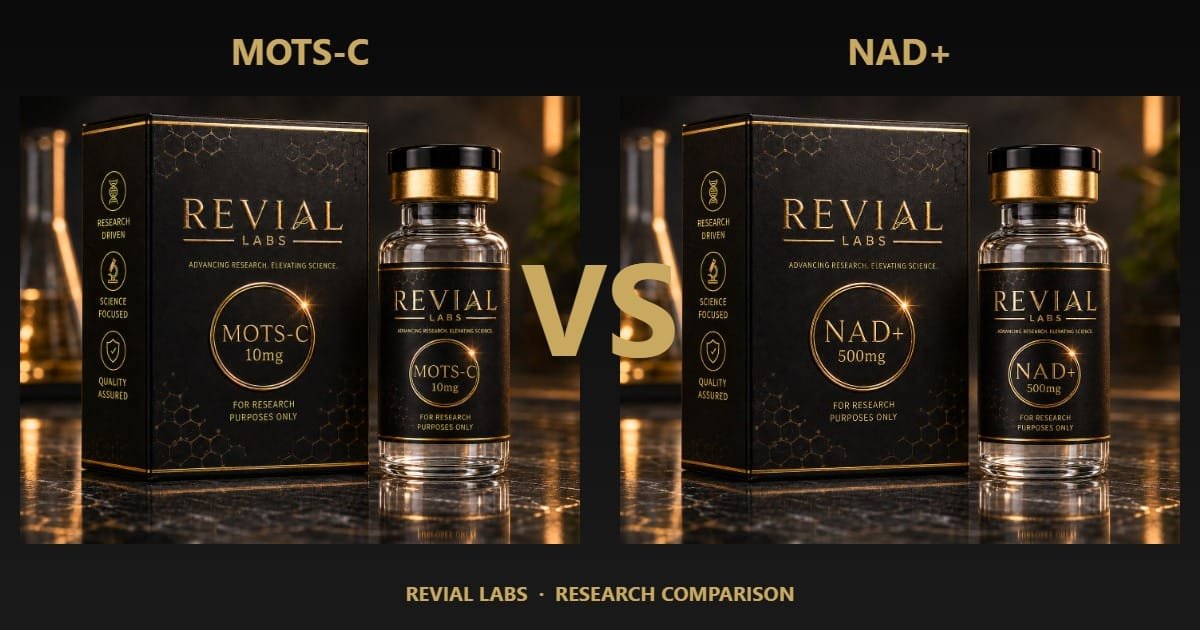
MOTS-C vs NAD+: A Research Comparison
MOTS-C and NAD+ are two of the most-discussed molecules in mitochondrial and longevity research. They are often mentioned in the same conversations because they operate in the same broad biological space — mitochondrial function, energy metabolism, and age-related decline — but they belong to entirely different classes of molecule. MOTS-C is a peptide encoded within the mitochondrial genome; NAD+ is a coenzyme central to redox reactions. This comparison walks through what each molecule actually is, the research applications, and how to think about them side-by-side in a research setting.
At a Glance
| Property | MOTS-C | NAD+ |
|---|---|---|
| Type of molecule | Peptide (16 amino acids) | Dinucleotide coenzyme |
| Origin | Encoded within the mitochondrial genome | Endogenous coenzyme, present in every cell |
| Molecular weight | 2174.61 g/mol | 663.43 g/mol |
| CAS number | Not standard (peptide sequence) | 53-84-9 |
| Primary role | Signalling molecule (AMPK pathway) | Redox cofactor and enzyme substrate |
| Primary research heritage | Metabolic signalling and mitochondrial biogenesis | Sirtuins, PARPs, redox biology, ageing |
Two Very Different Categories of Molecule
The most important thing to understand about this comparison is that MOTS-C and NAD+ are not the same category of molecule. Grouping them together is only useful because they intersect at mitochondrial biology and metabolic ageing research — biologically they operate in entirely different ways.
MOTS-C (Mitochondrial Open Reading Frame of the 12S rRNA-c) is a 16-amino-acid peptide. What makes it unusual is that its coding sequence is located within the mitochondrial genome — mitochondrial DNA — rather than in nuclear DNA like most peptides in the body. It was discovered in 2015 by researchers at the University of Southern California, and it functions as a signalling molecule, primarily by activating AMP-activated protein kinase (AMPK), a central sensor of cellular energy status.
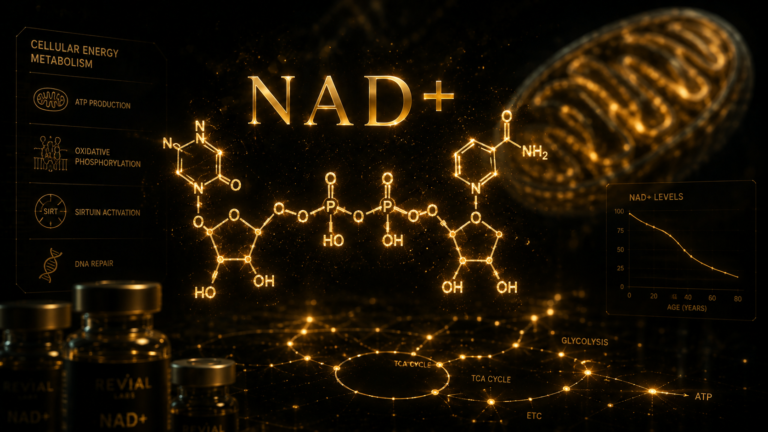
NAD+ (nicotinamide adenine dinucleotide) is a coenzyme — not a peptide at all — composed of two nucleotides (nicotinamide mononucleotide and adenosine monophosphate) linked by pyrophosphate. It has been known for decades as an essential cofactor in redox reactions across metabolism, and more recently as a substrate for a range of NAD+-consuming enzymes: sirtuins (SIRT1–7), PARPs (poly-ADP-ribose polymerases), and CD38. NAD+ levels decline with age in preclinical models, which has driven substantial research interest.
Areas of Research Investigation Compared
MOTS-C
- AMPK pathway signalling — investigation of AMPK activation as a downstream effect
- Glucose homeostasis models — insulin sensitivity and glucose disposal
- Mitochondrial biogenesis research — mitochondrial function and biogenesis
- Ageing research — MOTS-C decline with age and correlation with metabolic markers
- Exercise mimetic research — MOTS-C as an exercise-mimicking signal in skeletal muscle
NAD+
- Sirtuin activity studies — NAD+-dependent deacetylases and cellular ageing
- Mitochondrial research — NAD+ as substrate for oxidative phosphorylation
- DNA repair models — PARP-mediated repair, which consumes NAD+
- Ageing biology — NAD+ decline with age and precursor supplementation studies
- Metabolic and glycaemic research — NAD+ status in insulin signalling models
The overlap is at “mitochondrial function and metabolic ageing” — a very broad research theme where both molecules are relevant. The distinctive areas are MOTS-C’s AMPK pathway focus and NAD+’s much broader coenzyme role across redox biology, DNA repair, and sirtuin-mediated signalling.
Key Differences
1. Category of molecule
MOTS-C is a signalling peptide (it binds targets and triggers pathways). NAD+ is a coenzyme (it participates directly in enzyme-catalysed reactions and is consumed or reduced in the process). This is a fundamental biological distinction that shapes everything else about how they are studied.
2. Endogenous availability
NAD+ is present in every cell in the body, in millimolar concentrations in some tissues, and is continuously synthesised from precursors including nicotinamide riboside (NR) and nicotinamide mononucleotide (NMN). MOTS-C is present at much lower concentrations, with tissue-specific distribution, and declines with age at a rate distinct from NAD+.
3. Mechanism
MOTS-C acts through AMPK activation and downstream signalling cascades — a relatively focused mechanism. NAD+ acts as a substrate for dozens of enzymes across multiple pathways, so its mechanism is much broader and less pathway-specific.
4. Research literature depth
NAD+ has been studied for over a century and has one of the deepest research literatures of any small molecule in biology. MOTS-C is a much newer discovery (2015) with a rapidly growing but far smaller literature. This asymmetry is important for research context — MOTS-C claims should be treated with more caution given the shorter research history.
5. Precursor supplementation vs the molecule itself
In NAD+ research, much of the current work uses precursors (NR, NMN) rather than NAD+ directly, because cellular uptake of NAD+ itself is limited. For MOTS-C, the peptide itself is used directly in preclinical models. This is a practical difference that affects how research is designed.
Where They Overlap
The overlap is at the level of research theme: mitochondrial function, metabolic ageing, and energy homeostasis. Both molecules appear in longevity research programmes, both are of interest to research groups studying age-related metabolic decline, and both have been examined for effects on AMPK-related pathways. Some research groups have investigated whether MOTS-C and NAD+ (or NAD+ precursors) act synergistically or complementarily — an active area of investigation.
Product Specifications Compared
| Specification | MOTS-C | NAD+ |
|---|---|---|
| Molecular formula | C₁₀₀H₁₆₀N₂₆O₂₂S₂ | C₂₁H₂₇N₇O₁₄P₂ |
| Molecular weight | 2174.61 g/mol | 663.43 g/mol |
| Type | 16-amino-acid peptide | Dinucleotide coenzyme |
| Recommended solvent | Bacteriostatic water | Bacteriostatic water or sterile water |
| Vial size (Revial Labs) | 10mg | 500mg |
| Purity | ≥99% HPLC verified | ≥99% HPLC verified |
Choosing Between Them in a Research Context
- AMPK pathway signalling or mitochondrial biogenesis research — MOTS-C is the tool designed for this space.
- Sirtuin, PARP, or redox-cofactor research — NAD+ is essential; MOTS-C is not appropriate.
- DNA repair research — NAD+ is central to PARP-mediated repair; MOTS-C is not.
- General mitochondrial ageing research — both are appropriate; some research groups use both to examine complementary effects.
- Exercise mimetic research — MOTS-C has emerged as a specific interest here; NAD+ precursors are also studied in this space.
Frequently Asked Questions
Is MOTS-C a form of NAD+?
No. MOTS-C is a peptide (a chain of 16 amino acids). NAD+ is a dinucleotide coenzyme (two nucleotides linked by pyrophosphate). They belong to entirely different classes of molecule and are not chemically related.
Why are MOTS-C and NAD+ often mentioned together?
Because both are relevant to mitochondrial function and metabolic ageing research. They are frequently discussed in the same “longevity” or “mitochondrial health” contexts, but this reflects overlapping research themes rather than any structural or biological similarity between the two molecules.
Can MOTS-C and NAD+ be studied together?
Yes. Some research groups have investigated combination or complementary approaches, particularly in mitochondrial biogenesis and AMPK-related pathway research. Both intersect at AMPK signalling but through different mechanisms.
Do both molecules use bacteriostatic water for reconstitution?
Yes, though NAD+’s larger vial size (500mg) typically requires a larger reconstitution volume than a 10mg peptide vial. See How to Reconstitute Research Peptides for guidance.
Products Referenced in This Comparison
- MOTS-C 10mg
- NAD+ 500mg
- SLU-PP-332 — small-molecule ERR agonist also studied in mitochondrial research
Further Reading
Research Use Only
All products referenced in this article are supplied by Revial Labs for in vitro laboratory research use only. Not for human or veterinary use, not for use in food, cosmetics, or supplements, and not for diagnostic or therapeutic purposes. This article is a summary of published research directions and should not be interpreted as claims about either compound’s effects in humans.
Compounds referenced in this article
Revial Labs supplies the following research compounds discussed above, each independently COA tested and dispatched from the UK for laboratory research use only:
You can calculate reconstitution volumes with our free Peptide Reconstitution Calculator.