Glow Stack Explained: GHK-Cu, BPC-157 and TB-500 in One Vial
The Glow Stack has become one of the most searched-for peptide blends in the UK in 2026. It combines three of the best-studied compounds in dermal and tissue-repair research into a single lyophilised vial. Here is what is in it, why those three peptides are grouped together, how the ratio works, and what to check when sourcing it.
What is the Glow Stack?
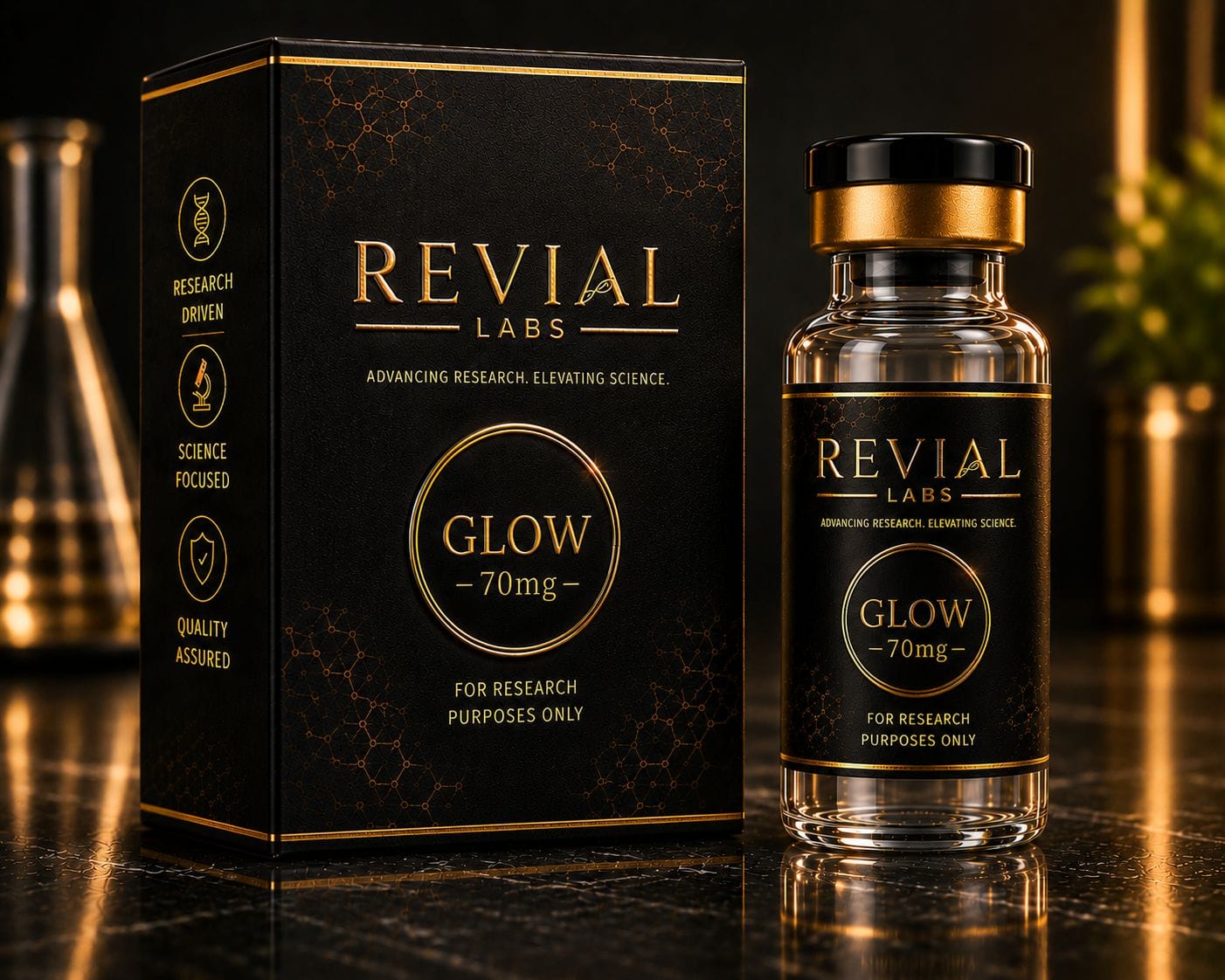
The Glow Stack is a pre-blended preparation of three peptides: GHK-Cu, BPC-157 and TB-500. The most common format, and the one supplied by Revial Labs, is a 70mg vial containing 50mg GHK-Cu, 10mg BPC-157 and 10mg TB-500. The name comes from the GHK-Cu component, whose research history is dominated by skin, collagen and dermal biology, while the other two peptides bring the tissue-repair literature that the “recovery” blends are known for.
It is supplied as a lyophilised (freeze-dried) powder for reconstitution in bacteriostatic water, strictly for laboratory research use.
The Three Components
GHK-Cu (50mg)
GHK-Cu is a naturally occurring tripeptide (glycine-histidine-lysine) bound to a copper ion, first isolated from human plasma in the 1970s. It is one of the most extensively studied peptides in dermatological research, with published work on fibroblast activity, collagen and elastin synthesis, glycosaminoglycan production and wound remodelling. The copper complex gives reconstituted solutions a characteristic pale blue colour. Read more in GHK-Cu: What It Is and What It’s Known For.
BPC-157 (10mg)
BPC-157 is a synthetic 15-amino-acid fragment derived from a protein found in gastric juice. It has a large preclinical literature in tendon, ligament, muscle and gastrointestinal repair models, as well as angiogenesis research. See BPC-157: What It Is and What It’s Known For.
TB-500 (10mg)
TB-500 is a synthetic peptide based on the active region of thymosin beta-4, a protein involved in actin regulation and cell migration. It is studied in wound-healing, re-epithelialisation and cytoskeletal research. See TB-500: What It Is and What It’s Known For.
Why These Three Are Studied Together
Each of the three peptides has an independent body of research in overlapping areas: re-epithelialisation, angiogenesis, extracellular matrix remodelling and connective-tissue repair. BPC-157 and TB-500 have been paired in preclinical work for years (see why BPC-157 and TB-500 are studied side by side). Adding GHK-Cu extends that pairing into skin, collagen and hair-follicle biology. A fixed-ratio blend gives research groups a single, consistent preparation for studying the combination rather than three separately reconstituted vials.
Why the 50:10:10 Ratio?
GHK-Cu is weighted far more heavily than the other two because it is typically studied at higher quantities in dermal models, while BPC-157 and TB-500 are generally referenced at lower amounts. The 50:10:10 split mirrors the way the three are most often weighted in the published literature and in community research protocols, with GHK-Cu as the lead compound and the repair peptides in supporting roles.
Glow Stack vs Klow vs Wolverine
- Glow Stack (70mg) — GHK-Cu 50mg, BPC-157 10mg, TB-500 10mg. The dermal and tissue-repair triad.
- Klow Blend (80mg) — the Glow Stack plus 10mg KPV, an anti-inflammatory fragment of alpha-MSH, for research that also covers inflammation pathways.
- Wolverine Blend (20mg) — BPC-157 and TB-500 only, 10mg each, typically studied in tendon, ligament and general tissue-repair contexts.
Reconstituting a Glow Stack Vial
The Glow Stack is reconstituted in bacteriostatic water like any single peptide. Because the vial holds 70mg in total, it is usually reconstituted with 2–3ml so the concentration stays practical to measure on a U100 insulin syringe. When calculating concentration, work from the total 70mg and remember the ratio: in every unit drawn, roughly 71% of the peptide content is GHK-Cu and about 14% each is BPC-157 and TB-500. Our free peptide calculator handles blends and breaks the result down per compound. For technique, see how to reconstitute research peptides.
Store reconstituted solution at 2–8°C, protected from light because of the copper content, and use within about four weeks.
What to Look for When Sourcing a Glow Stack
Blends raise an obvious quality question: with three compounds in one vial, how do you know each is present in the stated amount? Look for a supplier that verifies each component by HPLC before blending, can provide a batch-specific certificate on request, and publishes independent third-party test results for its single compounds. Revial Labs’ GHK-Cu batch, for example, was independently tested by Janoshik at 99.848% purity, with the certificate published on our lab results page. See why COA testing matters for what to check on any certificate.
Revial Labs supplies the Glow Stack 70mg from UK stock with tracked dispatch, alongside the individual GHK-Cu 100mg for researchers studying the copper peptide on its own.
This article is provided for educational purposes for laboratory research professionals. All Revial Labs compounds are supplied strictly for laboratory research use only and are not for human or veterinary use.