GHK-Cu UK: The Complete Research Guide (2026)
GHK-Cu, the copper peptide, is one of the most widely studied peptides in skin, collagen and tissue-repair research. It is also one of the few research peptides that most people have already heard of, thanks to its use in skincare. This guide explains what GHK-Cu is, what the published research covers, how research-grade material differs from cosmetic ingredients, and what to check when buying it in the UK.
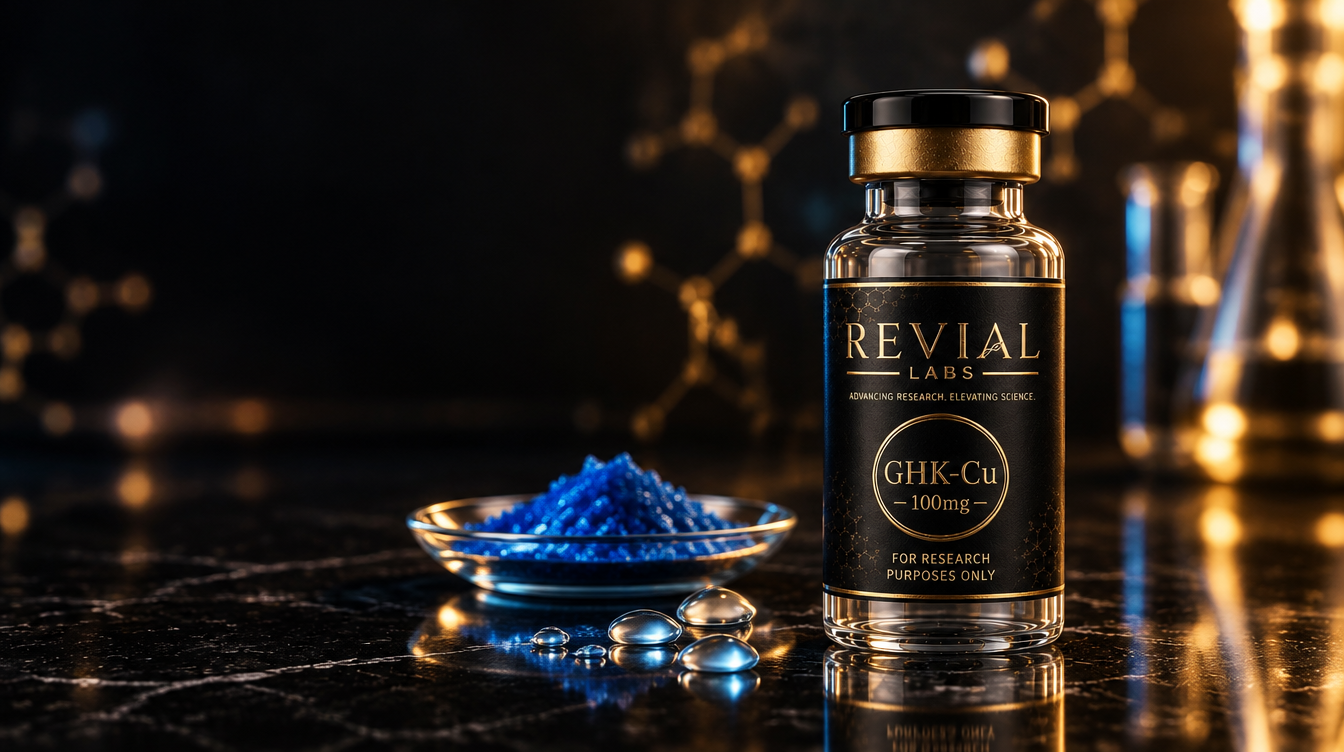
Quick summary: GHK-Cu is a naturally occurring tripeptide (glycine-histidine-lysine) bound to copper. It has been studied in collagen production, wound healing, antioxidant activity, gene expression and hair-follicle biology. Revial Labs supplies research-grade GHK-Cu 100mg at £44.99 from UK stock, and it is also the main component of the GLOW and KLOW blends.
Updated November 2026.
GHK-Cu at a Glance
| Also known as | Copper peptide, copper tripeptide-1 (its cosmetic ingredient name), glycyl-histidyl-lysine copper complex |
|---|---|
| Compound type | Naturally occurring tripeptide complexed with copper(II) |
| Sequence length | 3 amino acids (Gly-His-Lys) |
| Research format | Lyophilised (freeze-dried) blue powder in sealed 100mg vials. GHK-Cu 50mg is also included in the GLOW and KLOW blends |
| Research status | Research compound. Not an approved medicine, and research-grade material is for laboratory use only, not for cosmetic formulation |
What Is GHK-Cu?
GHK is a tripeptide made of three amino acids: glycine, histidine and lysine. It has a strong affinity for copper(II) ions and forms a complex known as GHK-Cu. It was first identified in human plasma in the early 1970s by researcher Loren Pickart, who observed that it influenced the behaviour of liver cells in culture.
GHK occurs naturally in plasma, saliva and urine. Published research reports that plasma levels decline with age, which is one of the reasons it has attracted so much interest in skin and ageing research. For a shorter overview, see GHK-Cu: What It Is and What It’s Known For.
Key Facts
| Property | Detail |
|---|---|
| Sequence | Gly-His-Lys (GHK), complexed with copper(II) |
| Molecular weight | Approximately 340 Da (GHK); approximately 404 Da as the copper complex |
| Appearance | Blue to blue-violet powder |
| Solution colour | Blue tint, from the copper |
| Main research areas | Skin, collagen, wound healing, hair follicles, antioxidant and gene-expression studies |
| Regulatory status | Not an approved medicine; research-grade material is for laboratory use only |
What Does the Research Cover?
- Collagen and extracellular matrix: laboratory studies report effects on collagen, elastin and glycosaminoglycan synthesis in fibroblast cultures.
- Wound healing: animal and cell studies have examined GHK-Cu in wound contraction, re-epithelialisation and blood-vessel formation.
- Antioxidant and anti-inflammatory activity: research has looked at its effects on free-radical damage and inflammatory signalling.
- Gene expression: computational analyses of gene-expression data have reported that GHK is associated with changes in the expression of a large number of human genes, many linked to repair and remodelling.
- Hair-follicle biology: GHK-Cu is a common tool in laboratory hair-follicle research.
Much of the evidence comes from cell culture and animal studies, and from cosmetic research on topical products. These findings describe research directions, not proven effects of research-grade material in people.
Research-Grade vs Cosmetic GHK-Cu
GHK-Cu is used as an ingredient in many skincare serums, usually at low concentrations. That cosmetic use is a separate category from research-grade GHK-Cu:
| Research-grade GHK-Cu | Cosmetic GHK-Cu products | |
|---|---|---|
| Form | Lyophilised powder in a sealed vial | Finished serum or cream |
| Concentration | Pure compound (e.g. 100mg per vial) | Low percentage in a formulation |
| Purpose | Laboratory research only | Consumer cosmetic use, under cosmetics regulations |
| Documentation | Certificate of Analysis (HPLC, mass spec) | Cosmetic safety assessment for the finished product |
Revial Labs GHK-Cu is research-grade material and is not supplied for cosmetic formulation or personal use.
GHK-Cu Products and Prices
| Product | Contents | Price |
|---|---|---|
| GHK-Cu 100mg | 100mg GHK-Cu | £44.99 |
| Glow Stack 70mg | GHK-Cu 50mg + BPC-157 10mg + TB-500 10mg | £74.99 |
| Klow Blend 80mg | Glow Stack + KPV 10mg | £79.99 |
| Retatrutide + GHK-Cu + KPV Research Stack | Three-compound research stack | £114.99 |
How to Check GHK-Cu Quality
- Batch COA with HPLC purity (≥98–99%) and mass spectrometry confirming identity.
- Correct colour: GHK-Cu powder should be blue to blue-violet. White or grey powder suggests the copper complex is missing or degraded.
- Independent testing you can verify. See why COA testing matters and our Lab Results.
- UK stock for fast delivery and no customs delays.
How to Choose a Reliable UK GHK-Cu Supplier
Many UK websites now list GHK-Cu, and quality varies widely. Before ordering for research, check that the supplier:
- Publishes an independent, batch-matched COA. The certificate should come from a third-party lab and be verifiable on that lab’s own website, with a batch number that matches the vials you receive.
- Shows HPLC purity and identity. Look for purity of 99% or more by HPLC, plus mass spectrometry confirming the compound is GHK-Cu.
- Is a real UK business. A registered company number, a UK address and UK stock mean no customs delays and someone accountable if something goes wrong.
- Supplies lyophilised vials. Freeze-dried powder is far more stable than pre-mixed pens. See Pre-Mixed Pens vs Lyophilised Vials.
- Makes no health or cosmetic claims. Legitimate research suppliers sell under clear research-use-only terms and do not give advice on human or cosmetic use.
- Prices sensibly. A price far below what other established suppliers charge is a warning sign, not a bargain.
Read more in Why Third-Party COA Testing Matters, and see every Revial Labs certificate on our Lab Results page.
Comparing GHK-Cu Prices
The fairest way to compare suppliers is price per mg: divide the vial price by the number of milligrams it contains. A 100mg vial at £50 works out at £0.50 per mg, for example. GHK-Cu is sold in a wider range of vial sizes than most peptides, so compare like with like, and always weigh price against the quality checks above.
Where Revial Labs sits: we focus on verified quality rather than being the cheapest. Every product is manufactured to 99% purity or higher by HPLC and independently tested, with certificates published on our Lab Results page. Orders ship from UK stock by Royal Mail Tracked, and you can reach a real person by email or WhatsApp if you have a question about your order. See what other researchers say on our reviews page.
Handling and Storage
GHK-Cu is reconstituted in bacteriostatic water for laboratory use, giving a blue solution. Copper peptides are particularly sensitive to light, so keep vials in their box or another dark container both before and after mixing. Store powder at 2–8°C and keep reconstituted solution refrigerated, using it within about four weeks. Our full guide on how to store peptides explains why, and the Peptide Reconstitution Calculator works out concentrations.
GHK-Cu vs Other Repair Peptides
GHK-Cu is often studied alongside BPC-157 and TB-500. The three have different mechanisms: GHK-Cu is closely linked to copper-dependent enzymes and matrix remodelling, BPC-157 to tendon and gut repair models, and TB-500 to actin regulation and cell migration. That complementary profile is the thinking behind the GLOW blend.
Related Research Guides
- KLOW vs GLOW blends explained
- Wolverine blend explained
- MOTS-c UK research guide
- NAD+ UK research guide
Frequently Asked Questions
Where can I buy GHK-Cu in the UK?
Revial Labs supplies research-grade GHK-Cu 100mg for £44.99 from UK stock, with same-day dispatch on weekday orders before 2pm and Royal Mail Tracked delivery.
What is GHK-Cu?
GHK-Cu is a naturally occurring tripeptide (glycine-histidine-lysine) bound to copper. It is studied in collagen, wound-healing, antioxidant and hair-follicle research.
Why is GHK-Cu blue?
The blue colour comes from the copper(II) in the complex. A blue powder and blue solution are normal.
Is research GHK-Cu the same as GHK-Cu in skincare?
It is the same compound, but research-grade GHK-Cu is a pure powder for laboratory use, while skincare products contain low concentrations in a finished formulation regulated as a cosmetic.
How should GHK-Cu be stored?
Keep powder at 2–8°C and away from light. After reconstitution, refrigerate the solution, protect it from light and use within about four weeks.
Is GHK-Cu legal in the UK?
Yes. GHK-Cu is not a controlled substance. Research-grade GHK-Cu is sold for laboratory research only and is not an approved medicine.
What other names is GHK-Cu sold under?
It is often called the copper peptide or copper tripeptide-1, its cosmetic ingredient name. Whatever the listing calls it, the certificate of analysis should identify the compound as GHK-Cu and confirm it by mass spectrometry.
How do I compare GHK-Cu prices?
Work out the price per mg by dividing the vial price by its size in mg. GHK-Cu comes in a wider range of vial sizes than most peptides, so compare the same size where you can. Only compare suppliers that publish an independent, batch-matched COA.
GHK-Cu vials or pens?
Lyophilised vials are the more stable format for storage and transport. Pre-mixed pens hold the peptide in solution, which degrades faster, and copper peptides are also sensitive to light.
Should I choose a GHK-Cu vial or a blend?
The 100mg vial suits studies that focus on GHK-Cu on its own or need to vary its amount. The GLOW and KLOW blends each contain 50mg GHK-Cu alongside other peptides at a fixed ratio, which suits studies designed around that combination.
All products supplied by Revial Labs are intended for in vitro laboratory research use only. They are not for human or veterinary use, and not for use in cosmetics. Nothing in this article is medical advice or a recommendation for use in people or animals.