HGH vs HGH Fragment 176-191: The Difference, and Understanding IU
Two of the most frequently confused compounds in growth-hormone research share almost the same name: HGH and HGH Fragment 176-191. Despite the similarity, they are structurally and functionally distinct, studied for different purposes, and even measured in different units. This article explains the difference between the two, and clears up one of the most common practical questions in the field — what an “IU” actually is and how it relates to reconstitution. Everything below is written for a laboratory research context.
HGH (Somatropin): the full hormone
HGH, or somatropin, is recombinant human growth hormone — a complete 191-amino-acid single-chain polypeptide identical in sequence to the growth hormone produced by the anterior pituitary gland. As the full molecule, it acts directly at the growth hormone receptor (GHR) and is studied across a broad range of research areas, including the GH/IGF-1 signalling axis, protein synthesis, lipid metabolism, and tissue repair. It is one of the most extensively investigated proteins in endocrine and metabolic research.
HGH Fragment 176-191: just the tail
HGH Fragment 176-191 is not the whole hormone — it is a short synthetic peptide corresponding only to amino acids 176 to 191 at the C-terminal “tail” of the HGH molecule. Because it is a small fragment rather than the intact protein, its research profile is different: it is studied primarily in the context of lipid metabolism and adipose-tissue research, and does not act on the full range of pathways associated with the complete hormone. In short, it represents one isolated region of HGH rather than the functioning hormone as a whole.
The key difference at a glance
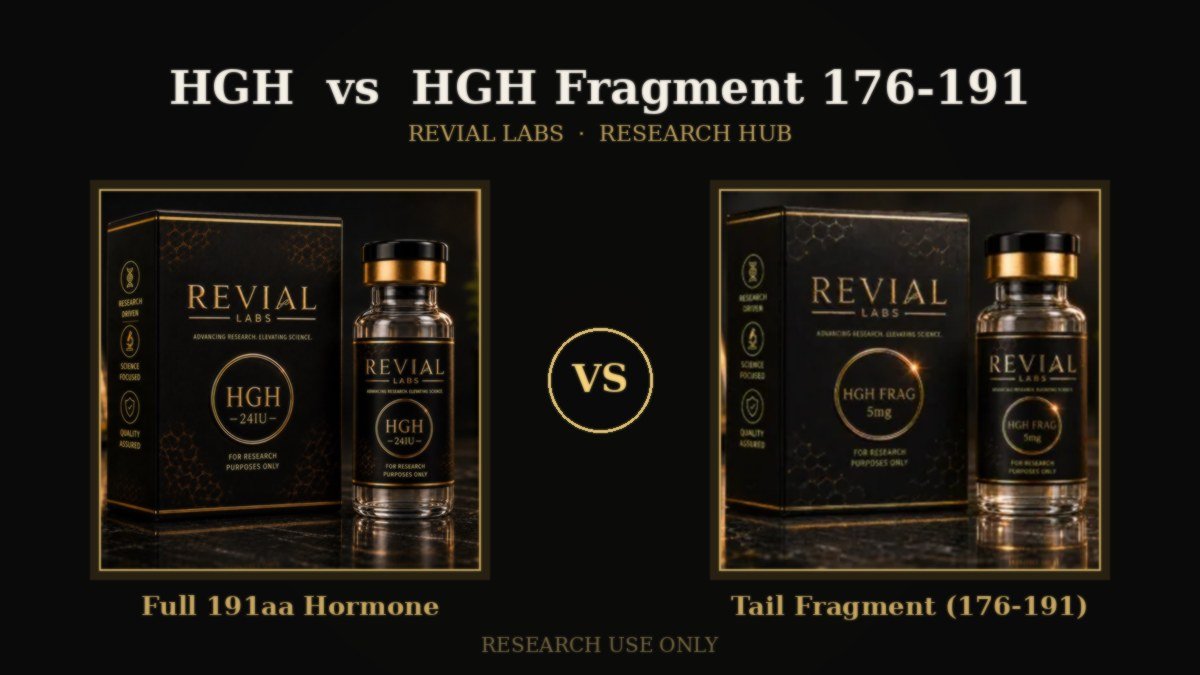
The simplest way to hold the distinction: HGH is the entire 191-amino-acid hormone; HGH Fragment 176-191 is a 16-amino-acid section of its tail. One is the complete signalling molecule studied across growth, metabolic, and regenerative research; the other is a small fragment studied for a narrower, metabolism-focused set of research questions. They are not interchangeable, and research findings on one do not transfer to the other.
Why HGH is measured in IU — and the Fragment in mg
This is where a lot of practical confusion arises. HGH is measured in International Units (IU), whereas most peptides — including HGH Fragment 176-191 — are measured in milligrams (mg). The reason is historical and biological: an IU is a measure of biological activity rather than mass, a convention that dates from a time when protein hormones could not be weighed with precision and were instead standardised by their measured potency.
For recombinant somatropin, the modern conversion is approximately 1 mg ≈ 3 IU (so a 24IU vial contains roughly 8 mg of protein). A milligram-measured fragment like HGH Fragment 176-191 does not carry an IU value, because it is quantified purely by mass. This is why you will see HGH vials labelled “24IU” while the Fragment is labelled “5mg” — the two use entirely different measurement systems.
What an IU means for reconstitution
Because HGH is measured in IU, calculating draw volumes works a little differently from a mg-based peptide, though the underlying maths is the same: total units divided by the volume of bacteriostatic water gives the concentration per millilitre. For example, a 24IU vial reconstituted in 1 mL of bacteriostatic water yields 24 IU/mL, so on a standard U-100 insulin syringe (where 100 units of syringe volume = 1 mL) a 10-unit draw would contain 2.4 IU.
The distinction worth remembering is that “units” on an insulin syringe are a measure of volume, not of hormone activity — they are not the same as the IU printed on the vial. Our Peptide Reconstitution Calculator handles both mg-based and IU-based reconstitution and converts to syringe volume automatically, which removes most of the arithmetic and the confusion.
Frequently Asked Questions
Is HGH Fragment 176-191 just a cheaper HGH?
No. It is a different compound entirely — a 16-amino-acid fragment of the HGH tail, not the full 191-amino-acid hormone. The two are studied for different research purposes and are not substitutes for one another.
Why is HGH measured in IU and not mg?
IU (International Units) measure biological activity rather than mass, a standardisation convention used historically for protein hormones. For recombinant somatropin the approximate conversion is 1 mg ≈ 3 IU.
How many mg is a 24IU vial of HGH?
At the standard conversion of roughly 1 mg ≈ 3 IU, a 24IU vial contains approximately 8 mg of recombinant somatropin.
Are the “units” on an insulin syringe the same as the IU on the vial?
No. Syringe units measure the volume drawn (100 units = 1 mL on a U-100 syringe), whereas the IU on the vial measures the hormone’s activity. Reconstitution converts between the two — see the Peptide Reconstitution Calculator.
Do HGH and HGH Fragment 176-191 need the same solvent?
Both are lyophilised powders reconstituted in bacteriostatic water for research use. The solvent is the same; the quantities and concentrations differ because one is measured in IU and the other in mg.
This article is provided for informational purposes in a research context. It is not medical advice and does not describe or recommend human use. Revial Labs products are supplied strictly for laboratory research use only and are not for human consumption.
Compounds referenced in this article
Revial Labs supplies the following research compounds discussed above, each independently COA tested and dispatched from the UK for laboratory research use only:
You can calculate reconstitution volumes with our free Peptide Reconstitution Calculator.