Bacteriostatic Water for Peptides: How Much to Use, How Long It Lasts and How to Store It
Bacteriostatic water is the least glamorous item in a peptide research kit and the one nothing works without. Almost every lyophilised peptide has to be dissolved in it before it can be measured. This guide covers what it is, how much to add to a vial, how concentration works, how long it lasts once opened, and how to store it.
What is Bacteriostatic Water?
Bacteriostatic water is sterile water containing 0.9% benzyl alcohol as a preservative. The benzyl alcohol doesn’t sterilise the water (it is already sterile); it stops bacteria multiplying inside the vial once the rubber septum has been punctured. That single property is what lets one vial be drawn from repeatedly over several weeks, and what lets a reconstituted peptide be stored and sampled over time.
Bacteriostatic Water vs Sterile Water
Sterile water for injection has no preservative. Once opened it should be used immediately and the rest discarded, because every needle puncture introduces a contamination risk with nothing in the vial to counter it. For a peptide vial that is reconstituted once and then drawn from over days or weeks, bacteriostatic water is the correct choice. A small number of peptides dissolve properly only in a mildly acidic solution; for those, see Bacteriostatic Water vs Acetic Acid Water.
How Much Bacteriostatic Water Should You Add?
The volume of water does not change how much peptide is in the vial; it only changes the concentration, meaning how much peptide is in each unit on the syringe. More water gives a weaker solution that is easier to measure precisely in small amounts; less water gives a stronger solution and fewer units per draw. As a general guide used in research settings:
- 2–5mg vials: usually 1ml
- 10mg vials: usually 1–2ml
- 20–30mg vials and blends: usually 2–3ml
- Very large vials (e.g. 100mg GHK-Cu): often 3ml or more
Worked Concentration Examples
On a 1ml U100 insulin syringe, 100 units equals 1ml, so 10 units equals 0.1ml. Concentration is simply peptide mass divided by water volume:
- 5mg + 1ml water = 5mg/ml, so 10 units contains 0.5mg
- 5mg + 2ml water = 2.5mg/ml, so 10 units contains 0.25mg
- 10mg + 1ml water = 10mg/ml, so 10 units contains 1mg
- 10mg + 2ml water = 5mg/ml, so 10 units contains 0.5mg
- 30mg + 3ml water = 10mg/ml, so 10 units contains 1mg
Rather than working it out by hand, use our free peptide reconstitution calculator, which takes the vial size and water volume and returns the concentration and exact syringe units for any target amount, including blends.
How Long Does Bacteriostatic Water Last?
- Unopened: until the expiry date printed on the vial, stored at room temperature away from light.
- Once punctured: the accepted guideline is 28 days from first use. Write the date on the vial when you first open it.
- Once mixed with a peptide: keep the reconstituted vial at 2–8°C and use it within about four weeks. Peptides themselves degrade in solution faster than in powder form, so the four-week guide applies even if the water is newer.
Storage Tips
- Keep reconstituted peptides in the fridge, never the freezer (freeze-thaw cycles damage peptide chains).
- Protect from direct light, especially copper-containing peptides like GHK-Cu.
- Always wipe the septum with an alcohol swab before each puncture.
- Use a fresh, sterile syringe for every draw.
Reconstitution Technique
Inject the bacteriostatic water slowly down the inside wall of the peptide vial rather than directly onto the powder, then swirl gently until the solution is clear. Never shake. Our full guide on how to reconstitute research peptides covers the technique step by step.
Which Size Vial to Buy
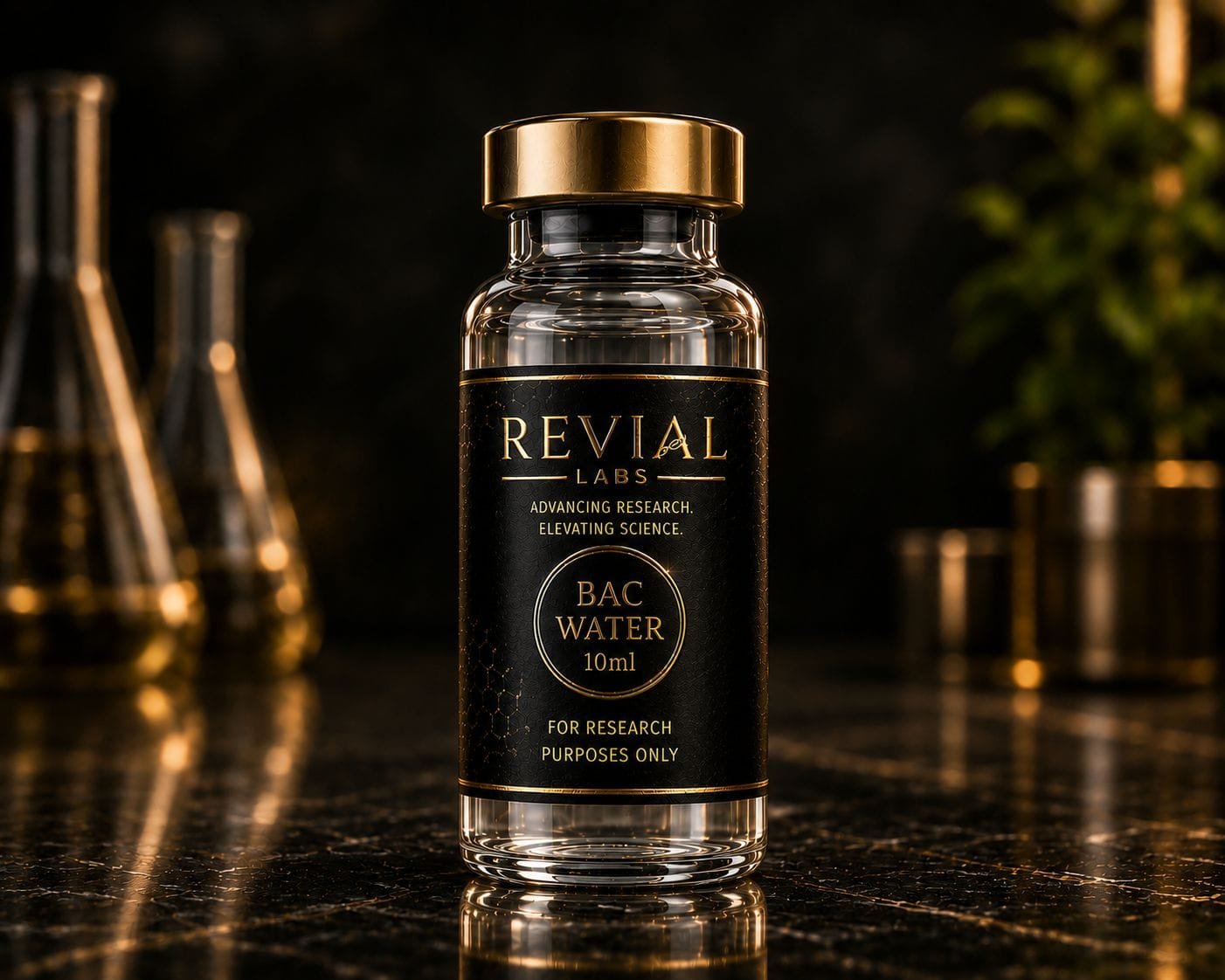
A 3ml vial covers one or two peptide vials and suits researchers starting a single compound. A 10ml vial is better value for anyone running several peptides, and stays usable for 28 days after opening. Revial Labs stocks bacteriostatic water in 3ml and 10ml vials from UK stock, and the peptide starter kit bundles bac water with U100 syringes and alcohol swabs (free with every £50 spent).
This article is provided for educational purposes for laboratory research professionals. All Revial Labs compounds and consumables are supplied strictly for laboratory research use only and are not for human or veterinary use.