TB-500 UK: The Complete Research Guide (2026)
TB-500 is one of the most widely studied peptides in tissue-repair research, and one of the most common partners for BPC-157 in research blends. This guide explains what TB-500 is, how it relates to the naturally occurring protein thymosin beta-4, what the published research covers, and what to check when sourcing it in the UK.
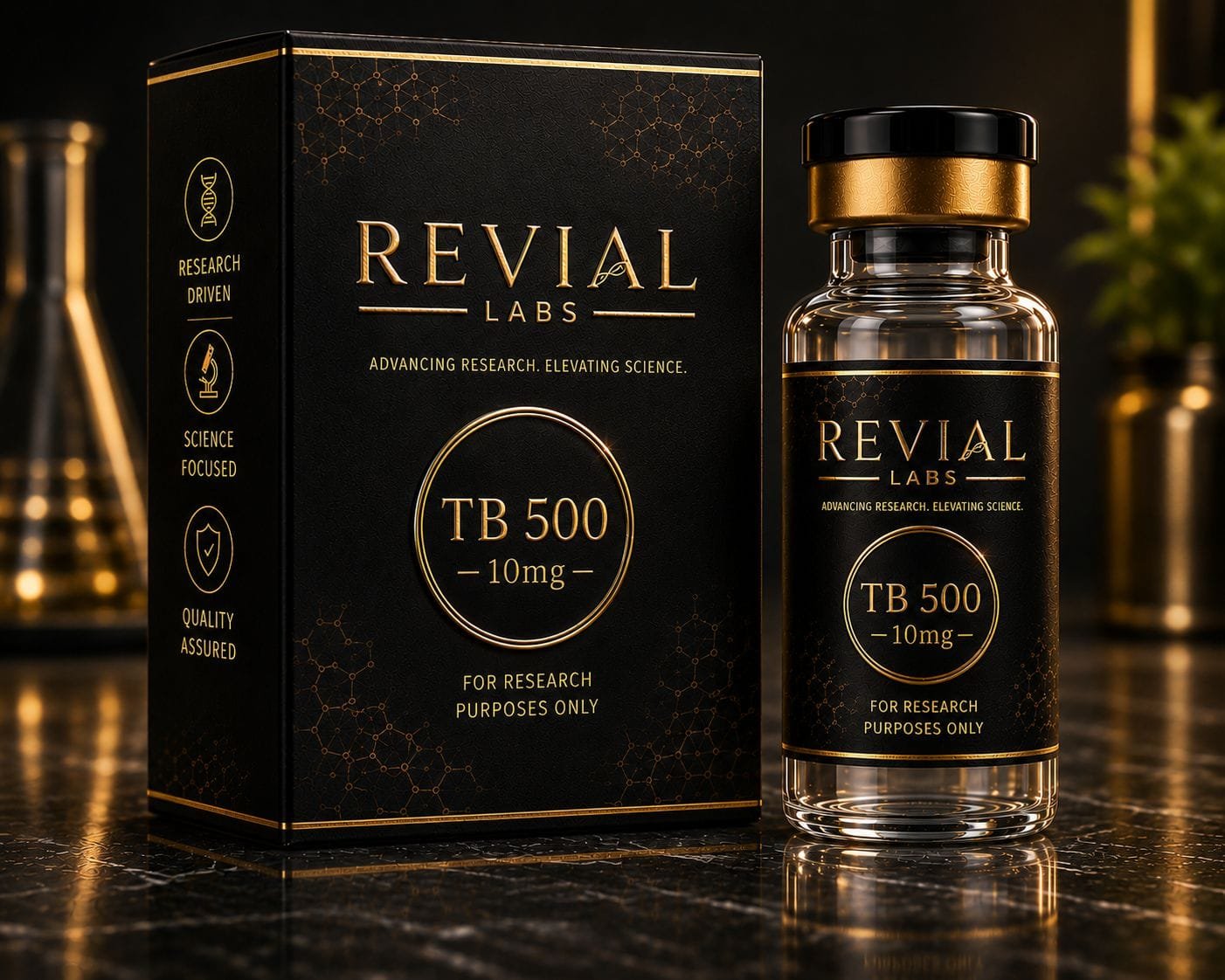
Quick summary: TB-500 is a synthetic peptide based on thymosin beta-4 (Tβ4), a protein involved in cell movement and the organisation of actin inside cells. Pre-clinical research has looked at Tβ4 in wound healing, blood-vessel formation and tissue repair. Revial Labs supplies research-grade TB-500 10mg as a lyophilised powder from UK stock, for laboratory research use only.
What Is TB-500?
Thymosin beta-4 is a 43-amino-acid protein found in most human and animal cells. Its best-known job is binding actin, the protein that forms part of the cell’s internal skeleton, which affects how cells change shape and migrate.
“TB-500” is the name used in the research market for synthetic peptide material based on Tβ4. Products differ: some are the full thymosin beta-4 sequence and some are shorter fragments, so it is worth checking exactly what a supplier’s certificate of analysis says was tested.
What Does the Research Look At?
Most of the evidence comes from cell and animal studies rather than human trials. The main areas are:
- Cell migration: how Tβ4’s actin-binding activity affects the movement of cells involved in repair.
- Wound-healing models: skin, corneal and other tissue-injury models in animals.
- Angiogenesis: the formation of new blood vessels.
- Cardiac research: animal studies of heart tissue after injury.
- Inflammation: how Tβ4 interacts with inflammatory signalling.
TB-500 and BPC-157
TB-500 is frequently studied alongside BPC-157. The two are thought to act through different mechanisms — TB-500 through actin and cell migration, BPC-157 through pathways linked to blood-vessel growth and nitric-oxide signalling — which is why researchers often look at them together. That combination is sold as the Wolverine blend, and TB-500 is also one of the components of the GLOW and KLOW blends.
Is TB-500 Legal in the UK?
TB-500 is not a controlled drug in the UK and is not a licensed medicine. It is supplied for laboratory research use only and is not approved for human or veterinary use. Thymosin beta-4 and its derivatives are prohibited in sport under the WADA list, which also matters in horse racing, where TB-500 testing is routine.
Handling and Storage
- Keep unopened vials of lyophilised TB-500 at 2–8°C, away from light; freezing is common for longer storage.
- Reconstitute with bacteriostatic water using sterile technique, letting the water run gently down the side of the vial.
- Refrigerate after reconstitution and avoid repeated freeze–thaw cycles.
Use our peptide reconstitution calculator to work out concentration, and see how to store peptides for more on stability.
What to Check When Sourcing TB-500
- An independent COA from a third-party lab such as Janoshik.
- Which sequence was tested — full thymosin beta-4 or a fragment.
- Purity of 98% or higher by HPLC, with mass spectrometry confirming identity.
- A matching batch number and a UK company you can contact.
Frequently Asked Questions
What is TB-500?
TB-500 is a synthetic research peptide based on thymosin beta-4, a protein involved in cell migration and actin organisation.
Is TB-500 the same as thymosin beta-4?
It is based on thymosin beta-4, but products vary between the full sequence and shorter fragments, so check the certificate of analysis.
Why is TB-500 combined with BPC-157?
The two are studied through different mechanisms in tissue-repair models, so researchers often examine them together, for example in the Wolverine blend.
Is TB-500 banned in sport?
Yes. Thymosin beta-4 and its derivatives, including TB-500, are prohibited under the WADA list.
How should TB-500 be stored?
Keep the powder at 2–8°C away from light, and refrigerate it after reconstitution.
All Revial Labs products are supplied strictly for laboratory research use. Not for human consumption, not for veterinary use, and no therapeutic claims are made.