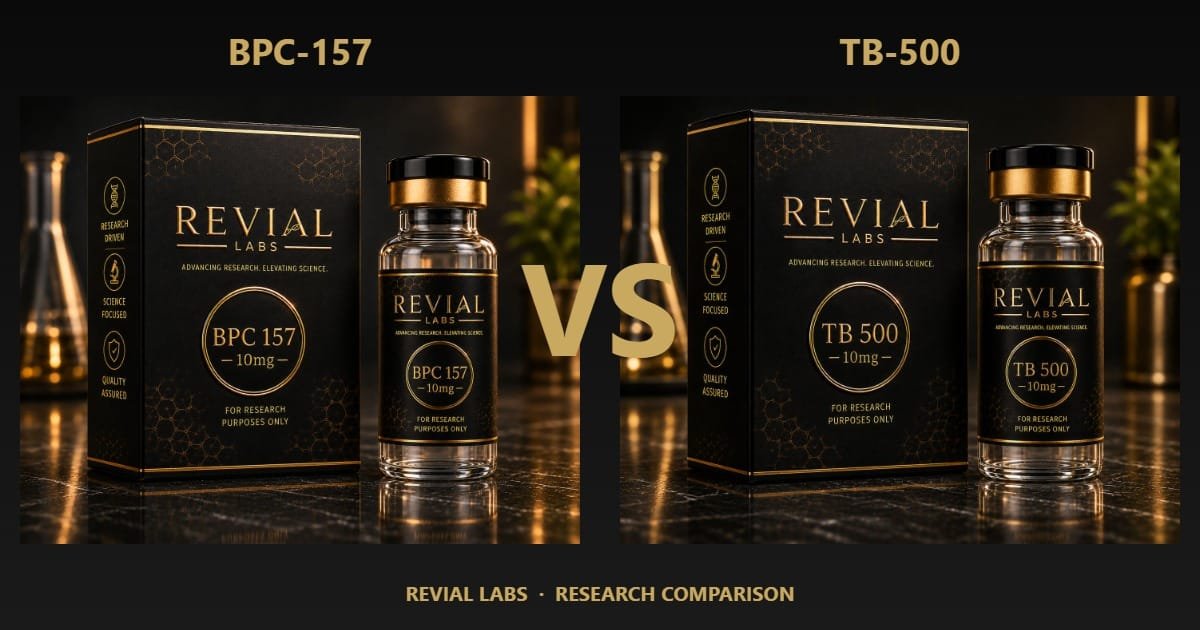
BPC-157 vs TB-500: A Research Comparison
BPC-157 and TB-500 are the two most extensively studied peptides in tissue-repair research. They are often mentioned together, sometimes assumed to be interchangeable, and frequently combined in preclinical studies — but they originate from entirely different biological sources and act through distinct mechanisms. This comparison walks through the origins, chemistry, research applications, and key differences between the two, positioned strictly within a research context.
At a Glance
| Property | BPC-157 | TB-500 |
|---|---|---|
| Origin | Fragment of Body Protection Compound, isolated from human gastric juice | Synthetic derivative of thymosin beta-4, first isolated from the thymus |
| Structure | Pentadecapeptide (15 amino acids) | 43-amino-acid peptide |
| Molecular weight | 1419.53 g/mol | 4963.55 g/mol |
| CAS number | 137525-51-0 | 77591-33-4 |
| Primary research heritage | Gastrointestinal protection and connective-tissue repair | Actin dynamics and cardiovascular/muscle repair |
| Discovered | Early 1990s (Sikirić et al.) | Late 1960s as thymosin β4; TB-500 form later |
Origins: Where Each Peptide Came From
The two compounds arrived in the research literature from very different starting points. BPC-157 was identified in the early 1990s by a research group at the University of Zagreb who were studying protective factors in human gastric juice. They isolated a larger protective peptide sequence they called Body Protection Compound (BPC), and BPC-157 is a synthetic 15-amino-acid fragment derived from that sequence. Its early research was focused almost entirely on the gastrointestinal tract — unsurprisingly, given its origin.
TB-500 is a synthetic derivative of thymosin beta-4 (Tβ4), a 43-amino-acid regulatory peptide that was first isolated from the thymus in the late 1960s. Tβ4 is one of the most abundant G-actin sequestering molecules in mammalian cells, playing a central role in cytoskeletal organisation. TB-500 emerged as a research and pharmaceutical development compound derived from this well-characterised parent molecule.
This origin difference matters. BPC-157 comes from a “damage response” background — gastric protective factors that evolved to defend tissue integrity. TB-500 comes from a “structural cell biology” background — cytoskeletal proteins involved in cell migration and shape. Both intersect at tissue repair, but they arrive there from opposite directions.
Areas of Research Investigation Compared
BPC-157
- Tendon and ligament repair models — connective tissue cell activity and growth factor signalling
- Gastrointestinal research — gut tissue integrity, ulcer models, inflammatory bowel models
- Angiogenesis studies — new blood vessel formation in tissue-repair contexts
- Neurological models — dopaminergic and serotonergic system interactions in animal studies
TB-500
- Actin dynamics research — G-actin sequestration and cytoskeletal organisation
- Tissue repair and wound-healing models — cell migration and re-epithelialisation
- Cardiovascular models — cardioprotection and post-infarction remodelling
- Corneal repair studies — epithelial cell migration in dermal and corneal models
Both compounds have been examined for angiogenesis and tissue repair — that is their obvious overlap. The distinctive research areas are BPC-157’s strong gastrointestinal literature and TB-500’s actin/cytoskeletal and cardiovascular literature.
Key Differences
1. Mechanism of action
BPC-157’s precise mechanism is still debated in the literature, but proposed pathways include modulation of nitric oxide synthesis, growth factor signalling (particularly VEGF), and interaction with dopaminergic and serotonergic systems. TB-500’s primary mechanism is much more clearly established: it binds G-actin monomers and prevents their polymerisation into F-actin filaments, giving it a direct role in cell shape and motility. The two are operating on completely different biological machinery.
2. Size and pharmacokinetics
BPC-157 is a small 15-residue peptide with reported stability in gastric acid — a feature that has generated substantial interest in oral bioavailability research. TB-500, at 43 residues, is a much larger molecule with different pharmacokinetic properties and is typically investigated via injection routes in preclinical models.
3. Research literature depth
Both compounds have substantial peer-reviewed literature, but the balance is different. BPC-157 has an unusually large body of published research from a small number of research groups (particularly the Sikirić group in Zagreb). TB-500 has a smaller but broader base of research spread across more institutions, largely because thymosin beta-4 was already a well-characterised endogenous molecule before TB-500 became a research target.
4. Regulatory status
Neither BPC-157 nor TB-500 is approved by the MHRA, FDA, or any equivalent regulatory body for human or veterinary use. TB-500 is banned by the World Anti-Doping Agency (WADA) for use in athletic competition. Both compounds are supplied strictly for laboratory research use.
Where They Overlap
The overlap between BPC-157 and TB-500 is in general tissue repair — both peptides have published research on tendon, ligament, and dermal wound-healing models. This overlap is why the two are so commonly investigated in combination in preclinical studies, and why they are frequently supplied together as a research blend. The Wolverine Blend combines both at 10mg each in a single vial for research groups planning to investigate them together.
Product Specifications Compared
| Specification | BPC-157 | TB-500 |
|---|---|---|
| Molecular formula | C₆₂H₉₈N₁₆O₂₂ | C₂₁₂H₃₅₀N₅₆O₇₈S |
| Molecular weight | 1419.53 g/mol | 4963.55 g/mol |
| Sequence length | 15 amino acids | 43 amino acids |
| Recommended solvent | Bacteriostatic water | Bacteriostatic water |
| Vial size (Revial Labs) | 10mg | 10mg |
| Purity | ≥99% HPLC verified | ≥99% HPLC verified |
Choosing Between Them in a Research Context
The question of “which is better” is not the right one — the two peptides have distinct research heritages and are appropriate for different research questions. A more useful framing is:
- Gastrointestinal or connective-tissue research — BPC-157 has the deeper literature.
- Actin dynamics, cytoskeletal, or cardiovascular research — TB-500 has the deeper literature.
- General tissue repair, wound healing, or angiogenesis — both are appropriate, and combination studies are common.
- Investigating additive or synergistic effects — the Wolverine Blend is the practical option.
Frequently Asked Questions
Are BPC-157 and TB-500 interchangeable?
No. Although they overlap in general tissue-repair research, they act through completely different biological mechanisms and have distinct research literatures. Substituting one for the other is not appropriate in a controlled research design.
Why are BPC-157 and TB-500 often studied together?
Because they act on different pathways within the same broad research theme (tissue repair), some preclinical work has examined whether combining them produces additive or complementary effects. Combination studies are common in the peer-reviewed literature.
Which came first, BPC-157 or TB-500?
Thymosin beta-4, the parent molecule of TB-500, was isolated first (late 1960s). BPC-157 was identified in the early 1990s.
Do both peptides use bacteriostatic water for reconstitution?
Yes. Both are typically reconstituted in bacteriostatic water. See How to Reconstitute Research Peptides for step-by-step guidance.
Products Referenced in This Comparison
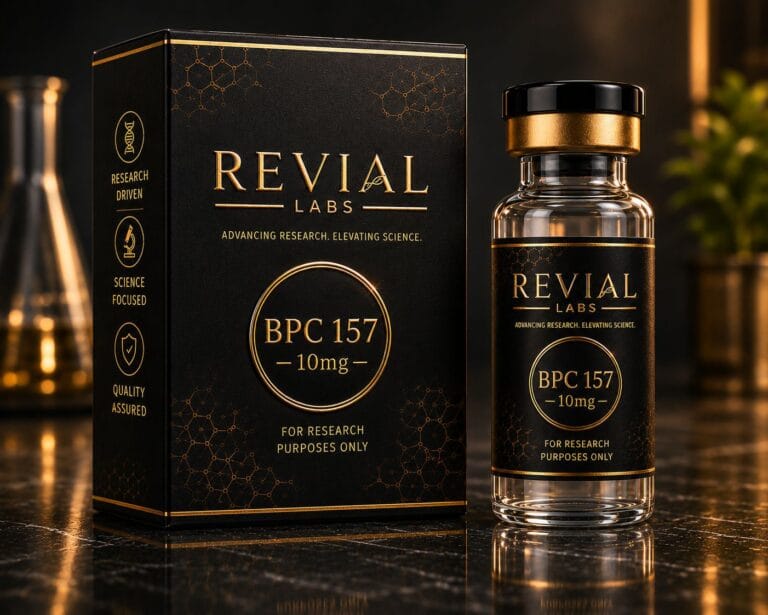
- BPC-157 10mg
- TB-500 10mg
- Wolverine Blend 20mg — combined BPC-157 and TB-500 preparation
- Klow Blend 80mg — BPC-157 and TB-500 alongside GHK-Cu and KPV
Further Reading
- BPC-157: What It Is and What It’s Known For
- TB-500: What It Is and What It’s Known For
- How to Reconstitute Research Peptides
- Why Third-Party COA Testing Matters in Peptide Research
Research Use Only
All products referenced in this article are supplied by Revial Labs for in vitro laboratory research use only. Not for human or veterinary use, not for use in food, cosmetics, or supplements, and not for diagnostic or therapeutic purposes. This article is a summary of published research directions and should not be interpreted as claims about either compound’s effects in humans.
Compounds referenced in this article
Revial Labs supplies the following research compounds discussed above, each independently COA tested and dispatched from the UK for laboratory research use only:
You can calculate reconstitution volumes with our free Peptide Reconstitution Calculator.