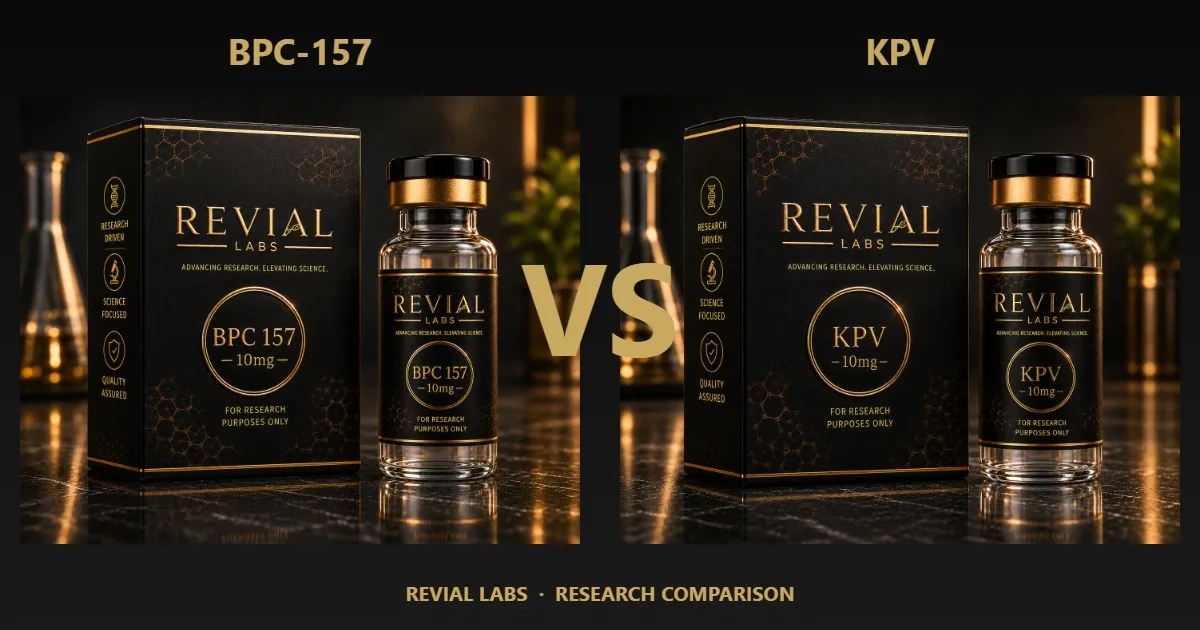
BPC-157 vs KPV: A Research Comparison
BPC-157 and KPV are two of the most widely referenced peptides in inflammation and gastrointestinal research, and they are often mentioned in the same contexts. They share overlapping research applications — particularly in colitis, wound healing, and mucosal repair models — but they are structurally very different, act through completely different biological pathways, and derive from unrelated parent molecules. This comparison walks through those differences, the areas of overlap, and how to think about them side-by-side in a research setting.
At a Glance
| Property | BPC-157 | KPV |
|---|---|---|
| Origin | Fragment of Body Protection Compound (gastric juice) | C-terminal tripeptide of α-MSH |
| Structure | Pentadecapeptide (15 amino acids) | Tripeptide (3 amino acids): Lys-Pro-Val |
| Molecular weight | 1419.53 g/mol | 342.44 g/mol |
| CAS number | 137525-51-0 | 67727-97-3 |
| Primary mechanism | Multiple pathways (NO synthesis, growth factor signalling) | NF-κB pathway suppression, melanocortin-related |
| Primary research heritage | General tissue repair and gastrointestinal protection | Anti-inflammatory (particularly gut and skin) |
Origins: Very Different Parent Molecules
BPC-157 is a synthetic 15-amino-acid fragment derived from a larger protective protein isolated from human gastric juice — Body Protection Compound. It was first characterised by a research group at the University of Zagreb in the early 1990s.
KPV is a much smaller molecule — just three amino acids (lysine-proline-valine) — that corresponds to the C-terminal three residues of alpha-melanocyte-stimulating hormone (α-MSH). Its parent, α-MSH, is a well-established anti-inflammatory neuropeptide, and researchers observed that this short C-terminal fragment retains most of the anti-inflammatory activity of the full molecule while lacking its pigmentary effects at the MC1R receptor.
These origins matter for understanding the research context. BPC-157 comes from a “tissue integrity” tradition — a molecule evolved to protect tissue from damage. KPV comes from an “immune signalling” tradition — a molecule extracted from the anti-inflammatory arm of a neuropeptide. Both intersect at gastrointestinal inflammation, which is why they appear together in the literature, but they arrive there from opposite biological angles.
Areas of Research Investigation Compared
BPC-157
- Tendon and ligament repair models — connective tissue cell activity and growth factor signalling
- Gastrointestinal research — gut tissue integrity, ulcer models, colitis models
- Angiogenesis studies — new blood vessel formation in tissue-repair contexts
- Neurological models — dopaminergic and serotonergic system interactions
KPV
- Anti-inflammatory pathway studies — NF-κB signalling suppression
- Inflammatory bowel disease models — colitis in rodent models, including oral and rectal routes
- Dermal inflammation research — atopic dermatitis and wound-healing models
- Melanocortin receptor pharmacology — comparative studies against full-length α-MSH
The overlap is at gastrointestinal inflammation and general wound healing. Beyond that, BPC-157’s literature is much broader (musculoskeletal, neurological, cardiovascular), while KPV’s is much more focused on the specific anti-inflammatory research theme.
Key Differences
1. Size
This is a dramatic difference. BPC-157 is 15 amino acids (1419 g/mol); KPV is 3 amino acids (342 g/mol). KPV is roughly one-fifth the mass of BPC-157. This has practical implications: KPV is cheaper to synthesise, easier to work with in aqueous solution, and has been investigated in oral and rectal delivery routes that would be more challenging for a larger peptide.
2. Mechanism
BPC-157’s mechanism is multifactorial and still debated in the literature — proposed pathways include nitric oxide synthase interaction, VEGF signalling, and dopaminergic/serotonergic modulation. KPV’s mechanism is more narrowly characterised — its primary effect appears to be suppression of NF-κB signalling, a central pathway in inflammation.
3. Research breadth vs research focus
BPC-157 has an unusually broad research literature covering many tissue types and biological systems. KPV has a much narrower literature focused almost entirely on anti-inflammatory contexts, particularly inflammatory bowel disease and dermal inflammation. If BPC-157 is a “generalist” repair peptide in the literature, KPV is a “specialist” anti-inflammatory peptide.
4. Delivery route in research
Both compounds are typically administered by injection in preclinical models, but KPV’s small size has made it a particular focus of research into oral and rectal delivery for gut-inflammation studies. BPC-157 has also been investigated for oral bioavailability, but the two peptides differ substantially in the delivery-route research that has developed around them.
Where They Overlap
The clearest overlap is in gastrointestinal inflammation research. Both compounds have peer-reviewed literature on colitis and ulcer models, and both are frequently invoked in research on inflammatory bowel disease. Some research groups have investigated the two in combination — the anti-inflammatory arm of KPV pairing with the broader tissue-integrity effects of BPC-157. The Klow Blend includes both alongside GHK-Cu and TB-500 for research groups working across this overlap.
Product Specifications Compared
| Specification | BPC-157 | KPV |
|---|---|---|
| Molecular formula | C₆₂H₉₈N₁₆O₂₂ | C₁₆H₃₀N₄O₄ |
| Molecular weight | 1419.53 g/mol | 342.44 g/mol |
| Sequence length | 15 amino acids | 3 amino acids (Lys-Pro-Val) |
| Parent molecule | Body Protection Compound (BPC) | Alpha-MSH C-terminus |
| Recommended solvent | Bacteriostatic water | Bacteriostatic water |
| Vial size (Revial Labs) | 10mg | 10mg |
| Purity | ≥99% HPLC verified | ≥99% HPLC verified |
Choosing Between Them in a Research Context
- Broad tissue-repair research spanning multiple systems — BPC-157 has the deeper literature.
- Specifically anti-inflammatory research or NF-κB pathway studies — KPV is the more focused tool.
- Inflammatory bowel disease models — both are appropriate; the two are sometimes combined.
- Research investigating oral or rectal delivery routes — KPV’s smaller size has driven more literature in this area.
- Musculoskeletal, cardiovascular, or neurological repair research — BPC-157 is more appropriate; KPV’s literature does not extend to these areas.
Frequently Asked Questions
Are BPC-157 and KPV interchangeable?
No. They differ in size by roughly a factor of four, act on different biological pathways, and have distinct research literatures. KPV is a specialist anti-inflammatory tool; BPC-157 is a much broader repair-family peptide.
Why is KPV so much smaller than BPC-157?
Because they derive from different parent molecules. KPV is only the C-terminal three residues of α-MSH — the segment researchers identified as retaining the anti-inflammatory activity without the pigmentary effect. BPC-157 is a full 15-amino-acid fragment of a much larger gastric protective protein.
Can BPC-157 and KPV be studied in combination?
Yes, and some research groups have investigated combined effects, particularly in gastrointestinal inflammation models. The Klow Blend combines both alongside GHK-Cu and TB-500 in a single vial for research groups planning combination studies.
Do both peptides use bacteriostatic water for reconstitution?
Yes. Both are typically reconstituted in bacteriostatic water. See How to Reconstitute Research Peptides for step-by-step guidance.
Products Referenced in This Comparison
- BPC-157 10mg
- KPV 10mg
- Klow Blend 80mg — combined preparation containing both
Further Reading
- BPC-157: What It Is and What It’s Known For
- BPC-157 vs TB-500: A Research Comparison
- How to Reconstitute Research Peptides
Research Use Only
All products referenced in this article are supplied by Revial Labs for in vitro laboratory research use only. Not for human or veterinary use, not for use in food, cosmetics, or supplements, and not for diagnostic or therapeutic purposes. This article is a summary of published research directions and should not be interpreted as claims about either compound’s effects in humans. Neither compound is approved by the MHRA, FDA, or any equivalent regulatory body.
Compounds referenced in this article
Revial Labs supplies the following research compounds discussed above, each independently COA tested and dispatched from the UK for laboratory research use only:
You can calculate reconstitution volumes with our free Peptide Reconstitution Calculator.