
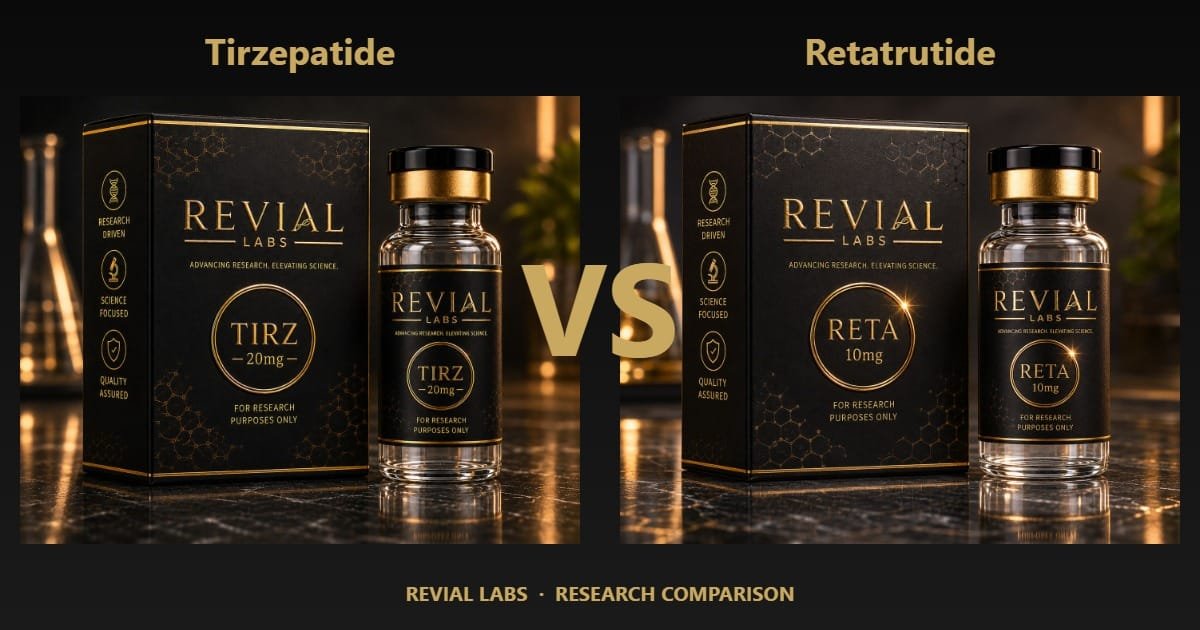
Tirzepatide vs Retatrutide: A Research Comparison
Tirzepatide and Retatrutide are two of the most significant incretin-based peptides developed by Eli Lilly, and both have generated substantial research interest in metabolic and glycaemic biology. They share a common design lineage — Retatrutide was developed after Tirzepatide, extending the same 39-amino-acid GIP-backbone architecture — but differ in one critical way: the number of receptor targets. This comparison walks through the shared design, the receptor differences, current research directions, and how to think about the two compounds side-by-side.
At a Glance
| Property | Tirzepatide | Retatrutide |
|---|---|---|
| Developer | Eli Lilly (LY3298176) | Eli Lilly (LY3437943) |
| Receptor targets | Dual: GIP + GLP-1 | Triple: GIP + GLP-1 + Glucagon |
| Structure | 39-amino-acid peptide | 39-amino-acid peptide |
| Molecular weight | 4813.53 g/mol | 4731.33 g/mol |
| CAS number | 2023788-19-2 | 2381089-83-2 |
| Regulatory status | FDA-approved 2022 (Mounjaro) | Phase 3 clinical trials underway |
Shared Design Lineage
Both compounds are engineered on a GIP-based backbone with 39 amino acids, non-coded residues at key positions to resist enzymatic degradation, and a C20 fatty diacid modification at Lys20 via a gamma-glutamic acid linker (with a PEG2 spacer in Retatrutide’s case). This shared architecture is not accidental — Retatrutide was developed as a next-generation extension of the Tirzepatide programme, and the two compounds are designed to look very similar to metabolic tissues, differing primarily in the fine-tuning of receptor engagement.
This is important context for research: the two are not entirely different molecules. They are closely related tools in an incretin-based programme, and the interesting research question is not “which one” but “what does adding the glucagon receptor arm do”.
The Critical Difference: Receptor Targets
Tirzepatide — Dual Agonist
Tirzepatide activates the GIP receptor (GIPR) and the GLP-1 receptor (GLP-1R). Both are incretin receptors — proteins that respond to hormones released from the gut in response to food intake and coordinate insulin secretion, glucose disposal, and appetite regulation. Combining GIP and GLP-1 agonism in a single molecule was the key innovation that distinguished Tirzepatide from earlier selective GLP-1 agonists like semaglutide.
Retatrutide — Triple Agonist
Retatrutide activates the same two incretin receptors plus the glucagon receptor (GCGR). Glucagon is traditionally understood as an opposing hormone to insulin — it raises blood glucose and drives hepatic gluconeogenesis — so adding glucagon receptor activation to an incretin agonist was, at first, counter-intuitive. But glucagon receptor activation also drives energy expenditure and fat oxidation, and the pharmacology of dosing appears to matter greatly. In preclinical models, the triple-agonist mechanism has been reported to produce metabolic effects distinct from those of dual GIP/GLP-1 agonism alone.
Areas of Research Investigation Compared
Tirzepatide
- Incretin receptor pharmacology — simultaneous GIP and GLP-1 signalling and downstream effects
- Glycaemic regulation models — insulin secretion, glucose homeostasis, pancreatic beta-cell activity
- Adipose tissue and energy balance research — GIP receptor activity in adipose tissue
- Comparative incretin research — head-to-head studies against selective GLP-1 agonists
Retatrutide
- Triple-receptor pharmacology — investigation of concurrent GIPR, GLP-1R, and GCGR activation
- Metabolic regulation models — glucose homeostasis, insulin sensitivity, hepatic fat metabolism
- Energy expenditure research — glucagon receptor activity and basal metabolic rate
- Comparative incretin research — head-to-head studies against dual GIP/GLP-1 agonists including Tirzepatide
Key Differences
1. Number of receptors
This is the headline difference. Tirzepatide activates two receptors; Retatrutide activates three. The addition of glucagon receptor agonism is where the two compounds diverge biologically and, most likely, in their eventual clinical profiles.
2. Development stage
Tirzepatide is FDA-approved (2022) and marketed as Mounjaro (for type 2 diabetes) and Zepbound (for weight management). Retatrutide is investigational — Phase 3 clinical trials are underway as of the time of writing, but it is not yet approved by any regulatory body for human use.
3. Research literature depth
Tirzepatide has a substantially deeper research literature simply because it has been in circulation longer and has an approval package behind it. Retatrutide’s literature is smaller but growing rapidly, with a strong focus on comparative studies against Tirzepatide as the closest reference compound.
4. Regulatory status of the research compound
Neither compound as supplied by Revial Labs is intended for human use. Tirzepatide is a prescription medication in the UK, and its research-supplied form should be treated with the same care as any other investigational compound — restricted to laboratory research contexts.
Product Specifications Compared
| Specification | Tirzepatide | Retatrutide |
|---|---|---|
| Molecular formula | C₂₂₅H₃₄₈N₄₈O₆₈ | Not fully disclosed (patent-protected) |
| Molecular weight | 4813.53 g/mol | 4731.33 g/mol |
| Sequence length | 39 amino acids | 39 amino acids |
| Fatty acid modification | C20 diacid at Lys20 via γ-Glu linker | C20 diacid at Lys20 via PEG2/γ-Glu linker |
| Recommended solvent | Bacteriostatic water | Bacteriostatic water |
| Purity | ≥99% HPLC verified | ≥99% HPLC verified |
Choosing Between Them in a Research Context
As with the BPC-157 / TB-500 comparison, “which is better” is not the right question — the two compounds are appropriate for different research questions. A more useful framing is:
- Established incretin research with a validated reference compound — Tirzepatide has the depth of literature.
- Investigation of glucagon receptor pharmacology in a metabolic context — Retatrutide is specifically designed to add this axis.
- Comparative studies of dual vs triple agonism — the two compounds are the natural head-to-head pair.
- Structure-activity relationship research — the shared architectural backbone makes them useful for isolating the effect of the added glucagon arm.
Frequently Asked Questions
Is Retatrutide “better” than Tirzepatide?
The two compounds are designed for different research questions. Retatrutide adds glucagon receptor agonism to the dual GIP/GLP-1 mechanism of Tirzepatide. Whether that additional activity produces preferable outcomes depends entirely on the research context and the outcomes being measured. Comparative claims outside a controlled research setting are not appropriate.
Why did Eli Lilly develop Retatrutide after Tirzepatide?
The triple-agonist approach was pursued to test whether glucagon receptor activation — particularly its effects on energy expenditure and hepatic fat metabolism — could complement the incretin arm of the mechanism. The GIP-backbone architecture that made Tirzepatide successful was the natural starting point for the extension.
Are Tirzepatide and Retatrutide the same size?
Both are 39-amino-acid peptides, but the molecular weights differ slightly (4813.53 vs 4731.33 g/mol) due to differences in residue composition and linker structure.
Do both peptides use bacteriostatic water for reconstitution?
Yes. Both are typically reconstituted in bacteriostatic water. See How to Reconstitute Research Peptides for step-by-step guidance.
Products Referenced in This Comparison
Further Reading
- Retatrutide: What It Is and What It’s Known For
- How to Reconstitute Research Peptides
- Why Third-Party COA Testing Matters in Peptide Research
Research Use Only
All products referenced in this article are supplied by Revial Labs for in vitro laboratory research use only. Not for human or veterinary use, not for use in food, cosmetics, or supplements, and not for diagnostic or therapeutic purposes. Tirzepatide is a prescription medication in the UK; the research-supplied form is intended solely for laboratory research and is not for human or veterinary use. Retatrutide is an investigational compound not approved by the MHRA, FDA, or equivalent regulatory bodies. This article is a summary of published research directions and should not be interpreted as claims about either compound’s effects in humans.
Compounds referenced in this article
Revial Labs supplies the following research compounds discussed above, each independently COA tested and dispatched from the UK for laboratory research use only:
You can calculate reconstitution volumes with our free Peptide Reconstitution Calculator.