How to Store Peptides: Before and After Mixing
Good storage is one of the simplest ways to protect your research. A high-purity peptide can degrade quickly if it is kept too warm, exposed to light or moisture, or frozen and thawed repeatedly. This guide covers how to store research peptides at every stage: on arrival, before mixing and after reconstitution.
Quick summary: Keep lyophilised (powder) peptides in the fridge at 2–8°C for regular use, or in the freezer at -20°C for long-term storage, sealed and away from light. Once reconstituted, keep the solution in the fridge at 2–8°C, never in the freezer door or at room temperature, and use it within about four weeks. Avoid repeated freeze-thaw cycles.
Why Peptides Degrade
Peptides are chains of amino acids, and several things can break or change them:
- Heat speeds up every degradation reaction.
- Moisture allows hydrolysis (water breaking peptide bonds) and deamidation.
- Light, especially UV, can damage sensitive residues. Copper peptides such as GHK-Cu are particularly light-sensitive.
- Oxygen oxidises residues such as methionine, cysteine and tryptophan.
- Agitation and freeze-thaw cycles can cause aggregation in solution.
- Microbial contamination is a risk once a vial is opened and in solution.
Lyophilisation (freeze-drying) removes almost all water, which is why powder vials are so much more stable than solutions.
Storage at a Glance
| State | Where | Temperature | Typical stability |
|---|---|---|---|
| Lyophilised, in transit | Sealed vial in packaging | Ambient | Stable for the days of normal shipping |
| Lyophilised, regular use | Fridge, in the box | 2–8°C | Many months |
| Lyophilised, long term | Freezer, sealed with desiccant | -20°C | Long term (often years) |
| Reconstituted | Fridge, upright, in the dark | 2–8°C | Use within about 4 weeks |
| Reconstituted | Room temperature | 15–25°C | Not recommended |
Exact stability depends on the peptide, so always check the product page and Certificate of Analysis for compound-specific guidance.
On Arrival
Lyophilised peptides are stable at room temperature for the few days it takes to ship within the UK. That is one advantage of buying from UK stock: Revial Labs orders are dispatched the same day on weekday orders before 2pm and usually arrive the next working day, rather than spending weeks in customs and warehouses.
When your order arrives:
- Check the vials are intact and the caps and seals are undamaged.
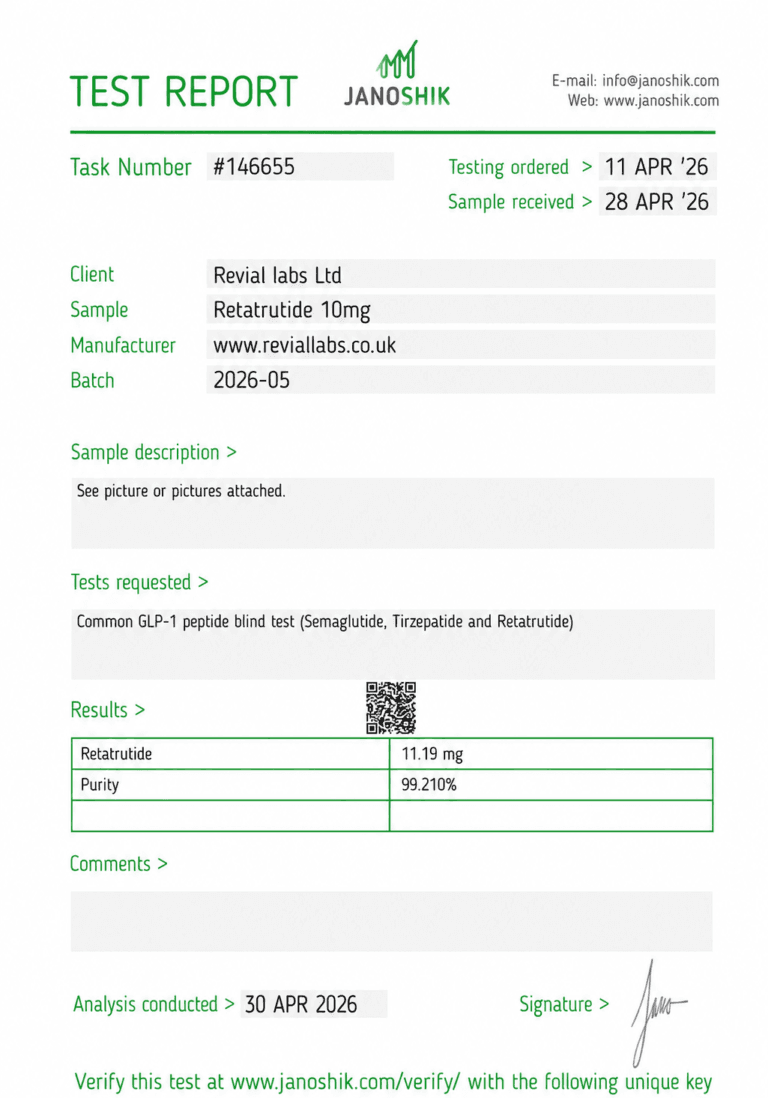
- Check the batch numbers against your Certificates of Analysis.
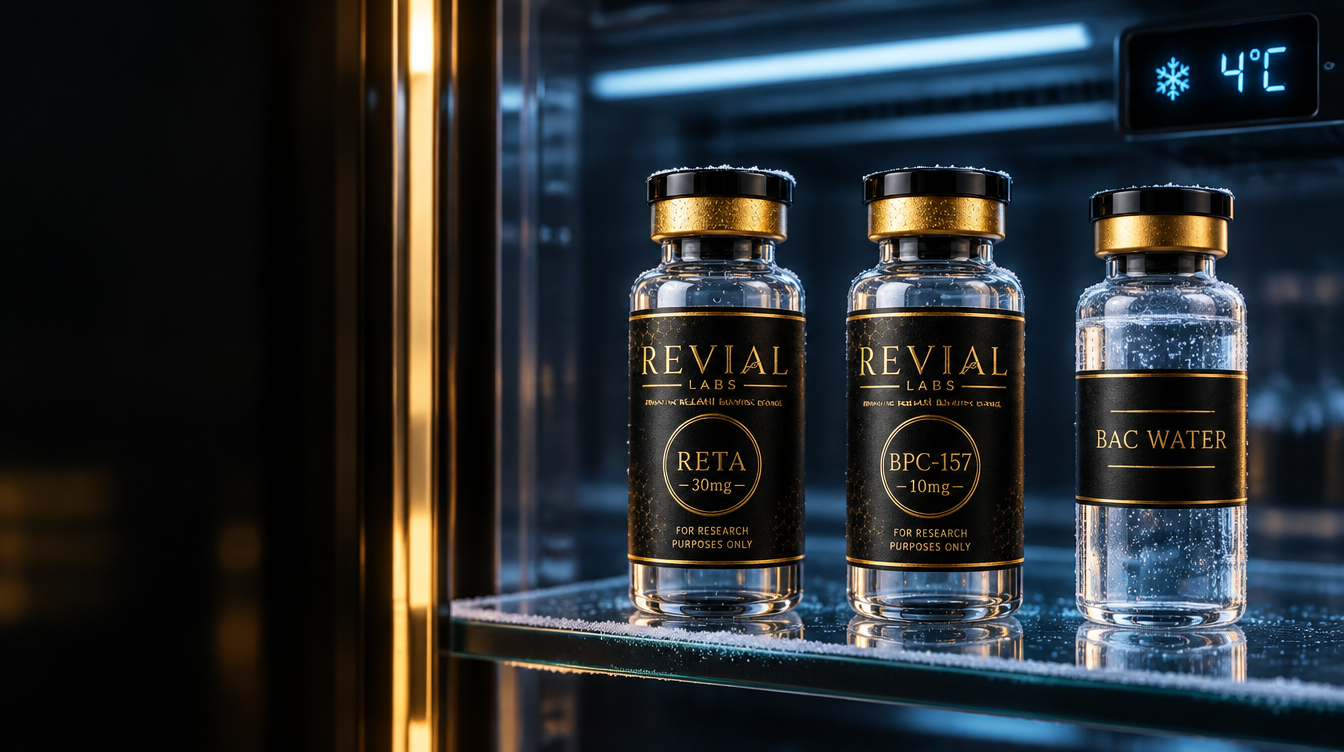
- Move the vials into the fridge, ideally still in their box to protect them from light.
Storing Peptides Before Mixing
Fridge or freezer?
For vials you will use within the next few months, a fridge at 2–8°C is ideal. For long-term storage, a freezer at -20°C slows degradation further. If you freeze lyophilised vials, keep them in a sealed bag or container with a desiccant sachet to prevent moisture.
Avoid condensation
When you take a cold vial out of the fridge or freezer, let it reach room temperature before opening or piercing the seal. Opening a cold vial pulls in warm, humid air, and condensation forms on the powder. That moisture is one of the main causes of degradation in stored powder.
Keep it dark and dry
Store vials in their box, or in an opaque container, away from the fridge light and away from the door, where the temperature swings every time it opens.
Storing Peptides After Mixing
Once a peptide is reconstituted, it becomes much less stable. Follow these rules:
- Refrigerate at 2–8°C straight away and keep it there.
- Use within about four weeks as a general guide. Some peptides are less stable than others, so check the product information.
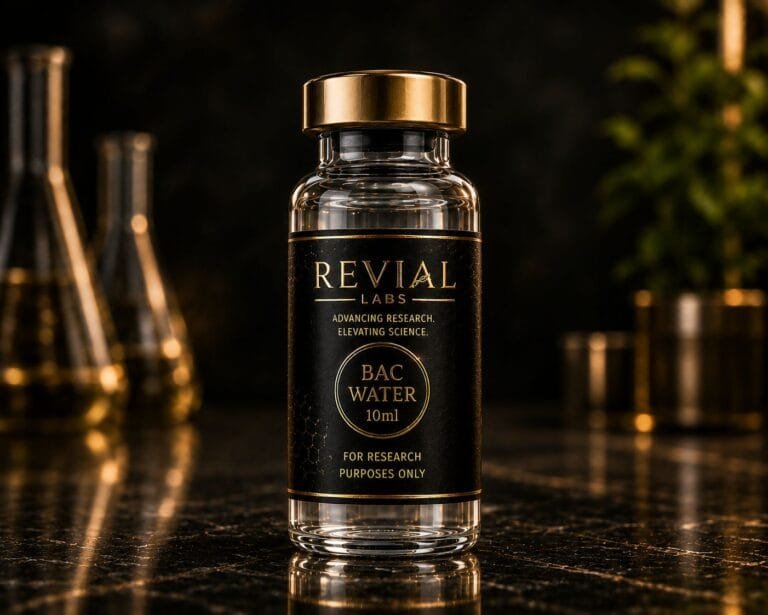
- Use bacteriostatic water for multi-use vials. Bacteriostatic water contains 0.9% benzyl alcohol, which inhibits bacterial growth each time the vial stopper is pierced. Sterile water has no preservative.
- Do not shake the vial. Swirl gently or roll it between your fingers to dissolve the powder.
- Do not refreeze reconstituted peptides unless you have split them into single-use aliquots. Repeated freeze-thaw cycles cause aggregation.
- Label each vial with the peptide, concentration and date of reconstitution.
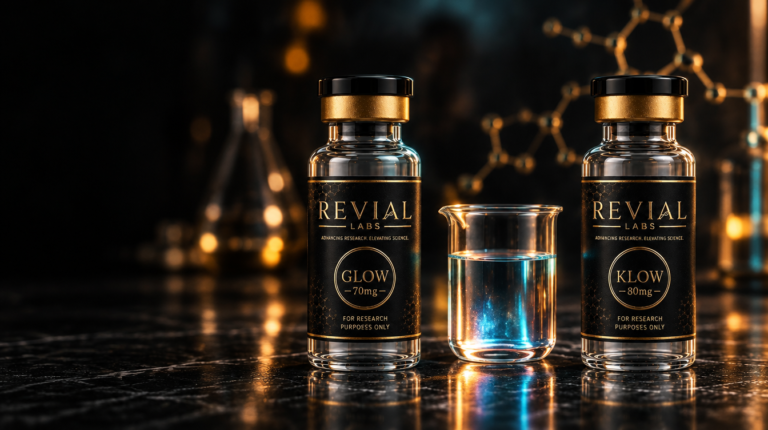
- Protect from light, especially copper peptides like GHK-Cu and blends such as KLOW and GLOW.
Some peptides dissolve better in acidic conditions and are reconstituted in acetic acid water rather than bac water. See bacteriostatic water vs acetic acid water for which to use.
Signs a Peptide May Have Degraded
- Powder that looks wet, sticky, shrunken or discoloured before mixing
- Cloudiness, particles or strands in the solution after mixing (a pale blue tint is normal for GHK-Cu)
- A solution that does not clear after gentle swirling
- Vials left at room temperature for long periods after reconstitution
If in doubt, discard the vial. Degraded material will compromise your results.
Peptide-Specific Notes
| Peptide | Storage notes |
|---|---|
| Retatrutide | Standard: 2–8°C powder, refrigerated solution, use within about 4 weeks |
| Tirzepatide | Standard: 2–8°C powder, refrigerated solution, use within about 4 weeks |
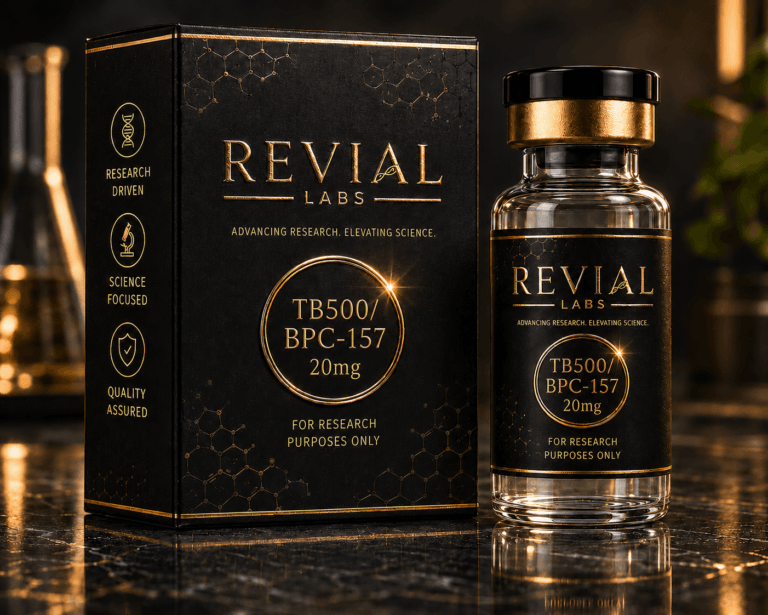
| BPC-157 | Comparatively stable peptide; standard refrigerated storage |
| GHK-Cu | Light-sensitive; keep in the dark both before and after mixing |
| KLOW and GLOW | Contain GHK-Cu, so protect from light |
Related Guides
- How to Reconstitute Research Peptides
- Bacteriostatic Water for Peptides
- Pre-Mixed Peptide Pens vs Lyophilised Vials
- Peptide Reconstitution Calculator
Frequently Asked Questions
Do peptides need to be refrigerated?
Lyophilised peptides are stable at room temperature for short periods such as shipping, but should be kept at 2–8°C for regular storage. Reconstituted peptides must always be refrigerated.
How long do peptides last after mixing?
As a general guide, use reconstituted peptides within about four weeks when kept at 2–8°C in bacteriostatic water. Some peptides are less stable, so check the product information.
Can you freeze peptides?
Lyophilised peptides can be frozen at -20°C for long-term storage. Reconstituted peptides should not be refrozen repeatedly, as freeze-thaw cycles cause damage.
How long do unopened peptide vials last?
Unopened lyophilised vials typically last many months in the fridge and longer in the freezer, provided they stay sealed, dry and away from light.
Do peptides go off in the post?
Lyophilised peptides are stable for the few days of normal UK shipping. Long international transit with customs delays is a greater risk, which is why UK stock matters.
Why let a vial warm up before opening?
Opening a cold vial lets warm, humid air in, and condensation forms on the powder. Letting it reach room temperature first prevents this.
All products supplied by Revial Labs are intended for in vitro laboratory research use only. They are not for human or veterinary use, and nothing in this article is medical advice or a recommendation for use in people or animals.