
MOTS-c UK: The Complete Research Guide (2026)
MOTS-c is one of the most talked-about peptides in metabolic and ageing research, and one of the few that is encoded not in the cell nucleus but in the mitochondria. This guide explains what MOTS-c is, what the published research has looked at so far, how it is handled in the lab, and what to check when sourcing it in the UK.
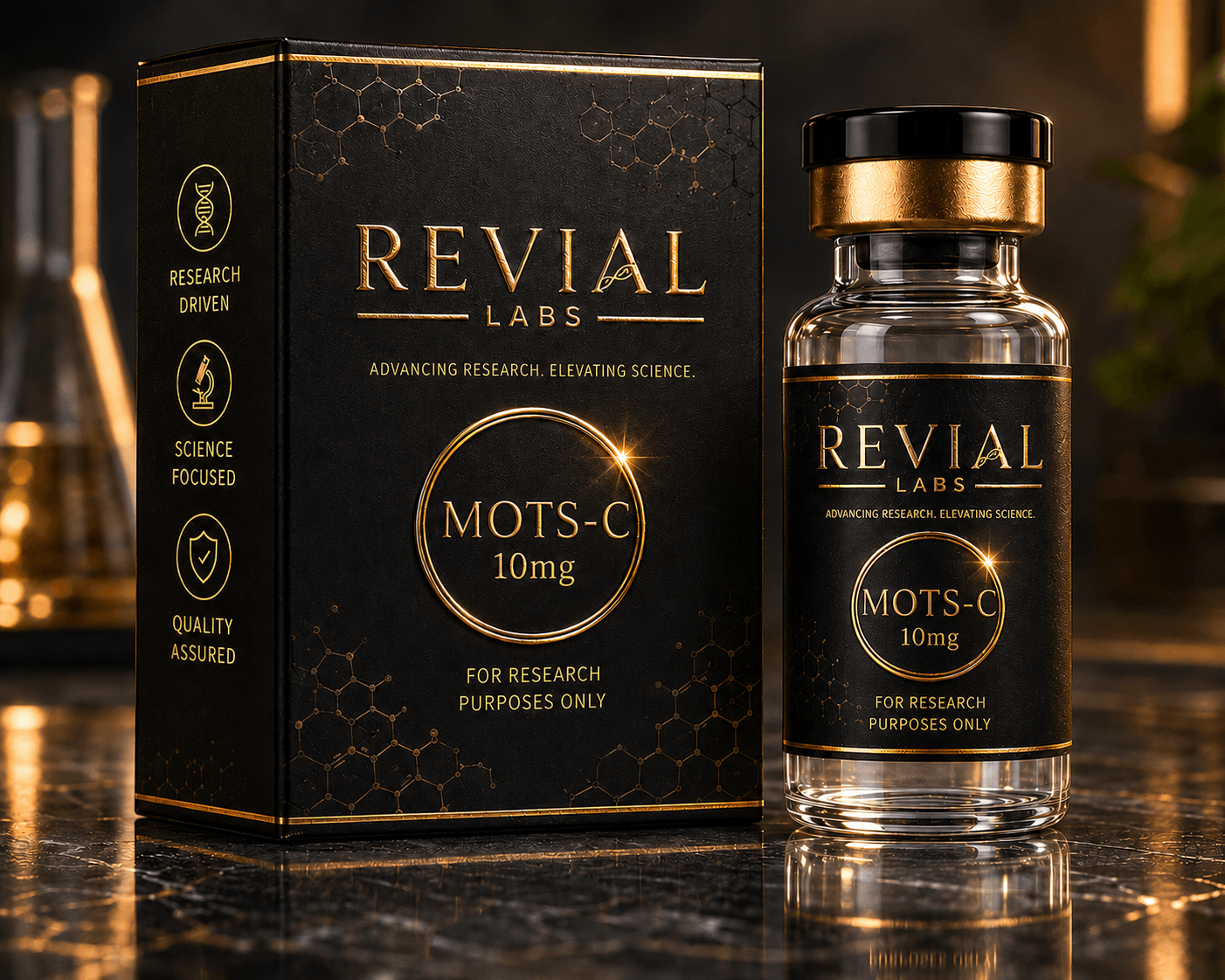
Quick summary: MOTS-c is a 16-amino-acid peptide encoded within mitochondrial DNA. Since it was first described in 2015 it has been studied in cell and animal models of metabolism, exercise physiology and ageing. Revial Labs supplies research-grade MOTS-c 10mg as a lyophilised powder from UK stock, for laboratory research use only.
What Is MOTS-c?
MOTS-c stands for mitochondrial open reading frame of the 12S rRNA type-c. It belongs to a small family of “mitochondrial-derived peptides” — short peptides encoded by mitochondrial DNA rather than nuclear DNA. Its sequence is 16 amino acids long (MRWQEMGYIFYPRKLR).
It was first reported by Lee and colleagues in Cell Metabolism in 2015. Their work suggested that mitochondria do not only produce energy but may also send signals to the rest of the cell using peptides like MOTS-c, which helped open up a new area of research into mitochondrial signalling.
What Does the Research Look At?
Most published MOTS-c work so far is pre-clinical — cell cultures and animal models — so findings should not be read as established effects in people. The main research themes are:
- Metabolic signalling: studies have examined MOTS-c’s relationship with the AMPK pathway and the folate–methionine cycle, both central to how cells manage energy.
- Glucose handling in animal models: early mouse studies looked at insulin sensitivity and responses to high-fat diets.
- Exercise physiology: MOTS-c levels in muscle and blood have been measured around exercise, and animal studies have explored physical capacity in ageing models.
- Ageing: because mitochondrial function changes with age, MOTS-c is studied as one possible link between mitochondria and age-related decline.
For a wider look at how mitochondrial and metabolic peptides are being studied, see our Research Hub.
MOTS-c and Other Mitochondrial Research Compounds
MOTS-c is often discussed alongside other compounds used in mitochondrial and cellular-energy research, in particular NAD+, a coenzyme at the centre of cellular metabolism, and SS-31, a peptide that targets the inner mitochondrial membrane. They act at different points, so researchers usually treat them as separate tools rather than interchangeable ones.
Is MOTS-c Legal in the UK?
MOTS-c is not a controlled drug in the UK and is not a licensed medicine. It is supplied for in-vitro and laboratory research only. It is not approved for human or veterinary use, and nothing in this guide is a recommendation to use it in people. Anyone working in sport should check the current World Anti-Doping Agency (WADA) prohibited list, which covers many metabolic modulators and peptides.
Handling and Storage
MOTS-c is supplied as a lyophilised (freeze-dried) powder. As with most research peptides:
- Store unopened vials in a fridge at 2–8°C, away from light; for long-term storage, freezing is common.
- Reconstitute with bacteriostatic water using sterile technique, and refrigerate the solution afterwards.
- Avoid repeated freeze–thaw cycles once reconstituted.
Our peptide reconstitution calculator works out concentration from vial size and water volume, and our guide to storing peptides before and after mixing covers stability in more detail.
What to Check When Sourcing MOTS-c
- An independent certificate of analysis (COA) from a third-party lab such as Janoshik, not just the manufacturer.
- Purity of 98% or higher by HPLC, with mass spectrometry confirming identity.
- A batch number on the vial that matches the certificate.
- Clear research-use labelling and a UK company you can contact.
Frequently Asked Questions
What is MOTS-c?
MOTS-c is a 16-amino-acid peptide encoded in mitochondrial DNA, studied in research on metabolism, exercise physiology and ageing.
Who discovered MOTS-c?
It was first described by Changhan Lee and colleagues, published in Cell Metabolism in 2015.
Is MOTS-c a licensed medicine in the UK?
No. MOTS-c is not licensed as a medicine and is supplied for laboratory research use only.
How should MOTS-c be stored?
Keep the powder at 2–8°C away from light. After reconstitution, keep the solution refrigerated and avoid repeated freezing and thawing.
Can I calculate MOTS-c reconstitution online?
Yes. Our free peptide reconstitution calculator works out concentration from the vial size and the volume of bacteriostatic water used.
All Revial Labs products are supplied strictly for laboratory research use. Not for human consumption, not for veterinary use, and no therapeutic claims are made.