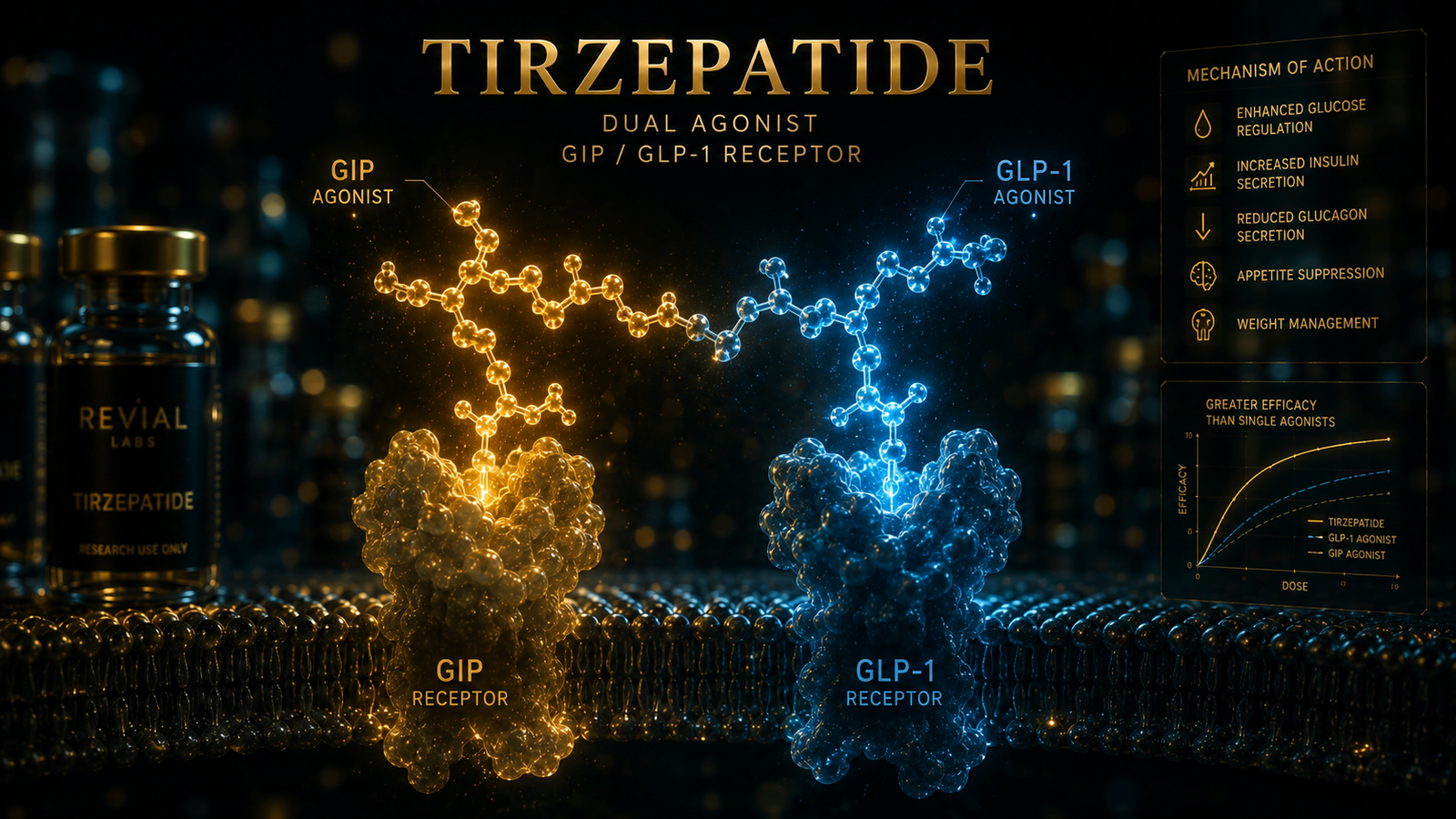
Tirzepatide: What It Is and What It’s Known For
Tirzepatide is one of the most extensively studied dual-receptor peptides in current metabolic research. Here is what it is, what sets it apart from related compounds, and what to look for when sourcing it.
What is Tirzepatide?
Tirzepatide is a synthetic 39-amino-acid peptide belonging to the incretin class. It is a dual agonist, acting on two hormone receptors: GLP-1 (glucagon-like peptide-1) and GIP (glucose-dependent insulinotropic polypeptide). It was developed by Eli Lilly, and its design — using a fatty acid modification for extended half-life — allows once-weekly administration in clinical and research settings. It is supplied for research as a lyophilised powder.
What is it known for?
Tirzepatide is best known as the compound at the centre of the SURMOUNT (obesity) and SURPASS (type 2 diabetes) clinical trial programmes — among the largest metabolic research programmes conducted in the last decade. In the SURMOUNT-1 trial, the 15mg dose produced approximately 22.5% body weight reduction at 72 weeks, a result that generated significant research interest in dual receptor agonism and set a new benchmark in the incretin class at the time.
Why the Dual-Receptor Design Matters
Most earlier GLP-1 compounds targeted the GLP-1 receptor alone. Tirzepatide’s addition of GIP receptor activity is considered a key contributor to its stronger metabolic outcomes relative to GLP-1 monoagonists. GIP receptors are expressed in fat tissue and play a role in fatty acid storage and metabolism — a mechanism largely absent from GLP-1-only research protocols. The interaction between GLP-1 and GIP signalling pathways remains an active area of mechanistic research.
Tirzepatide and Retatrutide
Tirzepatide shares its core 39-amino-acid GIP-backbone architecture with retatrutide, Eli Lilly’s subsequent triple agonist. The key structural difference is that retatrutide adds glucagon receptor activity as a third target. Researchers studying the incremental contribution of glucagon receptor activation frequently use both compounds in comparative models. For a detailed side-by-side, see Tirzepatide vs Retatrutide.
Properties Researchers Value
- Dual-receptor activity — GLP-1 and GIP co-activation is the defining mechanistic feature.
- Well-characterised — among the most extensively studied incretin-class peptides in the research literature.
- Defined structure — 39 amino acids, confirmed by mass spectrometry.
- Solubility — reconstitutes readily in bacteriostatic water for standard preparation.
What to Look for When Sourcing
Look for an independent COA confirming HPLC purity and mass spectrometry identity from a named third-party laboratory. With high-demand research compounds, independent verification is essential. See our guide on why COA testing matters.
Reconstitution
Tirzepatide is supplied lyophilised and dissolved in bacteriostatic water before use. Our reconstitution guide covers technique and storage. Concentration and draw volumes can be calculated using our Peptide Calculator.
Our Approach
At Revial Labs, our Tirzepatide UK vials are supplied with a batch-specific COA so researchers can verify identity and purity before use. For UK status, research-grade vs Mounjaro, and a supplier checklist, see our Tirzepatide UK guide. Every compound we supply is intended strictly for laboratory research.
Compounds Referenced in This Article
This article is provided for educational purposes for laboratory research professionals. All Revial Labs compounds are supplied strictly for laboratory research use only and are not for human or veterinary use.