Tesamorelin: What It Is and What It’s Known For
Tesamorelin occupies a distinctive position in the growth-hormone-axis research space — it is one of the few synthetic peptides with robust human clinical trial data behind it. Here is what it is and what it is known for.
What is Tesamorelin?
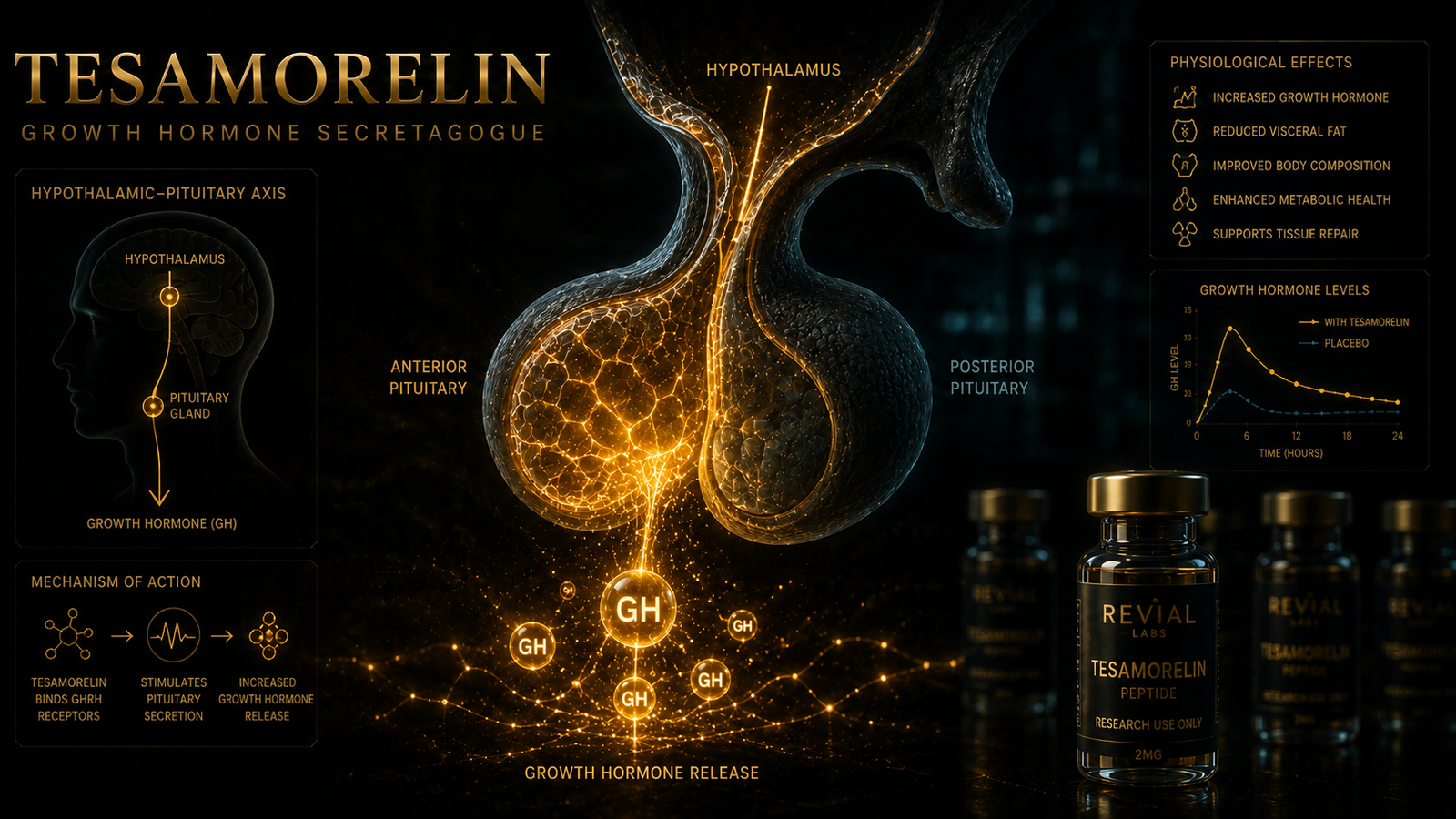
Tesamorelin is a synthetic analogue of growth hormone-releasing hormone (GHRH), the hypothalamic peptide that stimulates the pituitary gland to produce and release growth hormone (GH). It is a 44-amino-acid peptide — the full sequence of endogenous GHRH(1-44) — with a trans-3-hexenoic acid modification at the N-terminus that improves metabolic stability and extends its half-life. It is supplied for research as a lyophilised powder and reconstituted before use.
What is it known for?
Tesamorelin is best known for its role in HIV-associated lipodystrophy research. It is the active ingredient in Egrifta (Egrifta SV), the first FDA-approved GHRH analogue for a clinical indication — specifically the reduction of excess abdominal fat in HIV-positive patients with lipodystrophy. This gives Tesamorelin an unusually strong evidence base for a research peptide: its mechanism and safety profile are backed by randomised controlled trials and a regulatory approval pathway.
In research contexts beyond that indication, Tesamorelin is studied in body composition models, visceral adipose tissue biology, and in pairings with GHRPs (growth hormone-releasing peptides) for synergistic GH pulse amplification.
The GHRH Mechanism
Tesamorelin acts at GHRH receptors in the anterior pituitary, stimulating the production and pulsatile release of endogenous GH. This is distinct from direct GH administration — Tesamorelin works through the body’s own GH-release architecture rather than bypassing it. The resulting GH pulses then drive IGF-1 production in the liver, which mediates many of the downstream metabolic effects observed in research models.
The Ipamorelin Pairing
In research protocols, Tesamorelin is frequently studied alongside Ipamorelin — a selective GHRP that acts on the ghrelin receptor. The combination is of research interest because the two peptides act through completely different receptor pathways, producing what some research characterises as synergistic GH pulse amplification. For a full comparison, see Ipamorelin vs Tesamorelin.
Properties Researchers Value
- Strong evidence base — one of the few synthetic peptides with an FDA-approved clinical indication, providing a well-characterised safety and mechanism profile.
- Pituitary-mediated GH release — preserves the natural pulsatile architecture of GH secretion.
- Defined structure — 44 amino acids, confirmed by mass spectrometry.
- Reconstitution — dissolves readily in bacteriostatic water.
What to Look for When Sourcing
As a longer peptide, Tesamorelin is more complex to synthesise than shorter sequences — making purity verification important. Look for an independent COA confirming HPLC purity (≥98%) and mass spectrometry identity from a named third-party laboratory. Our guide on why COA testing matters explains what to check.
Reconstitution
Tesamorelin is supplied lyophilised and dissolved in bacteriostatic water before use. Our reconstitution guide covers the full process. Use the Peptide Calculator for concentration and draw volume calculations.
Our Approach
At Revial Labs, our Tesamorelin 10mg is independently tested by Janoshik Analytical. The current batch (RL260601) returned 98.286% HPLC purity with 10.57mg measured in a nominal 10mg vial, and the certificate can be verified directly on Janoshik’s website from our lab results page. It ships from UK stock with tracked delivery. Every compound we supply is intended strictly for laboratory research.
Compounds Referenced in This Article
This article is provided for educational purposes for laboratory research professionals. All Revial Labs compounds are supplied strictly for laboratory research use only and are not for human or veterinary use.