NAD+ UK: The Complete Research Guide (2026)
NAD+ is one of the most studied molecules in cellular-energy and ageing research. Unlike most of the compounds in our catalogue it is not a peptide at all, but a coenzyme found in every living cell. This guide explains what NAD+ is, why researchers are interested in it, how lyophilised NAD+ is handled in the lab, and what to check when sourcing it in the UK.
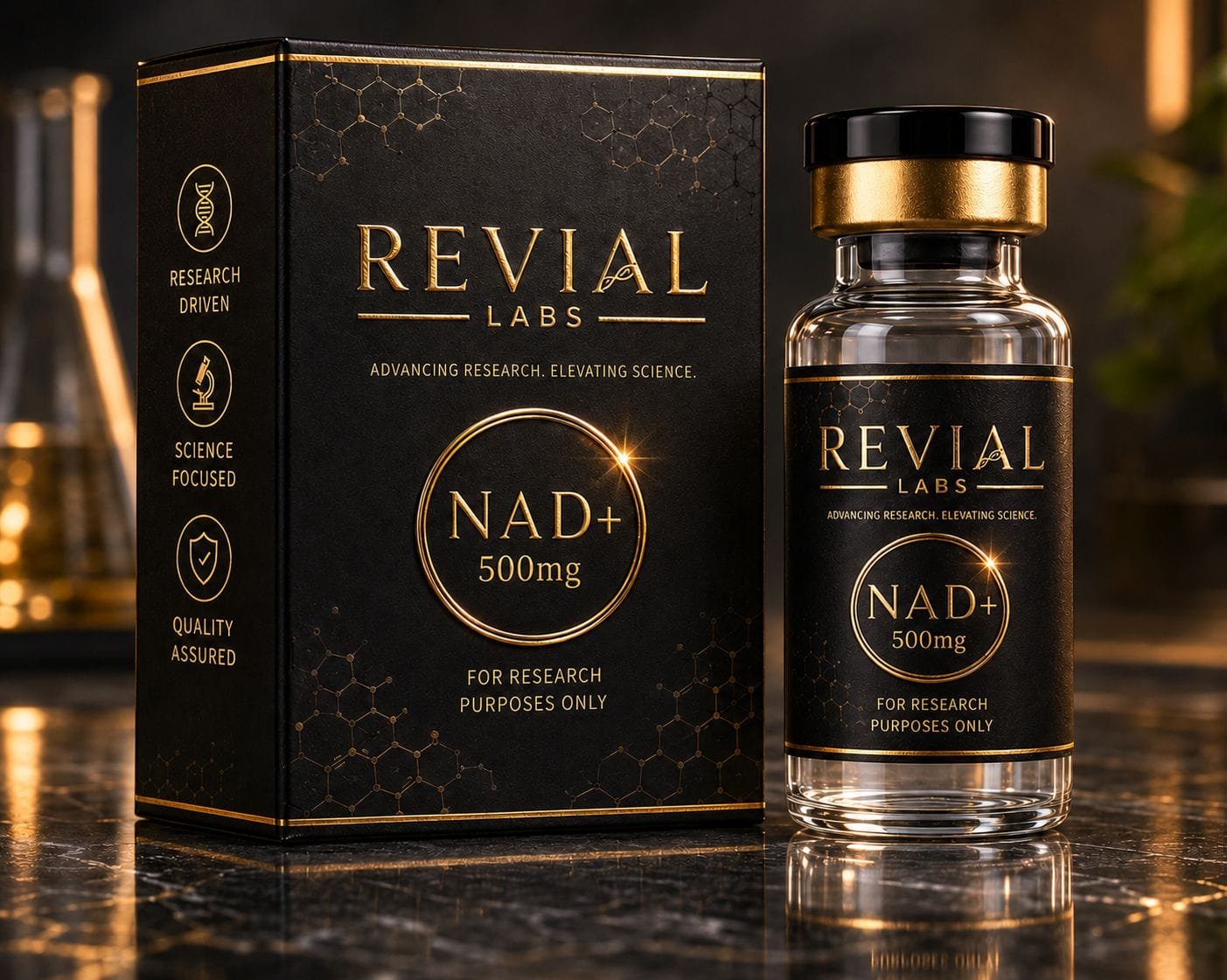
Quick summary: NAD+ (nicotinamide adenine dinucleotide) is a coenzyme involved in hundreds of metabolic reactions, and a key substrate for enzymes such as sirtuins and PARPs. Research interest centres on how NAD+ levels change with age and what that means for cellular metabolism and DNA repair. Revial Labs supplies research-grade NAD+ 500mg as a lyophilised powder from UK stock, for laboratory research use only.
Updated November 2026.
NAD+ at a Glance
| Also known as | Nicotinamide adenine dinucleotide (oxidised form). Often written NAD |
|---|---|
| Compound type | Coenzyme made from two nucleotides. Not a peptide |
| Composition | Molecular formula C21H27N7O14P2 |
| CAS number | 53-84-9 |
| Molecular weight | Approximately 663.4 g/mol |
| Research format | Lyophilised (freeze-dried) powder in sealed 500mg vials |
| Research status | Not a controlled substance in the UK. Supplied as a research compound for laboratory use only |
What Is NAD+?
Nicotinamide adenine dinucleotide exists in two main forms: NAD+ (oxidised) and NADH (reduced). Cells switch between the two to carry electrons in energy metabolism, including glycolysis and the citric acid cycle, and to feed the mitochondrial electron transport chain that produces ATP.
NAD+ is also consumed by several enzyme families as a substrate rather than simply recycled:
- Sirtuins — enzymes involved in gene regulation and cellular stress responses.
- PARPs (poly-ADP-ribose polymerases) — enzymes involved in DNA repair.
- CD38 — an enzyme whose activity is studied in relation to NAD+ decline.
Why Is NAD+ Studied in Ageing Research?
Several animal and human tissue studies have reported that NAD+ levels tend to fall with age. Because so many processes depend on it, researchers are investigating whether that decline is linked to changes in mitochondrial function, DNA repair and metabolic health. A large body of work also looks at NAD+ precursors such as nicotinamide riboside (NR) and nicotinamide mononucleotide (NMN), which the body can convert into NAD+.
Much of this research is still early and results are mixed, so it is best read as an active field of study rather than settled science.
NAD+ and Other Cellular-Energy Research Compounds
NAD+ is often discussed alongside MOTS-c, a peptide encoded in mitochondrial DNA, and SS-31, which targets the inner mitochondrial membrane. Each acts at a different point in cellular energy metabolism, so they are studied as separate tools.
Buffered vs Unbuffered NAD+
NAD+ is mildly acidic in solution. Some research-grade NAD+ is supplied buffered, meaning a pH buffer is included so the reconstituted solution sits closer to neutral. When comparing suppliers, check whether the product is buffered and what the stated content per vial is.
How to Choose a Reliable UK NAD+ Supplier
Many UK websites now list NAD+, and quality varies widely. Before ordering for research, check that the supplier:
- Publishes an independent, batch-matched COA. The certificate should come from a third-party lab and be verifiable on that lab’s own website, with a batch number that matches the vials you receive.
- Shows HPLC purity and identity. Look for purity of 99% or more by HPLC, plus mass spectrometry confirming the compound is NAD+.
- Is a real UK business. A registered company number, a UK address and UK stock mean no customs delays and someone accountable if something goes wrong.
- Supplies lyophilised vials. Freeze-dried powder is far more stable than pre-mixed pens or solutions. See Pre-Mixed Pens vs Lyophilised Vials.
- Makes no health claims. Legitimate research suppliers sell under clear research-use-only terms and do not give advice on human use.
- Prices sensibly. A price far below what other established suppliers charge is a warning sign, not a bargain.
Read more in Why Third-Party COA Testing Matters, and see every Revial Labs certificate on our Lab Results page.
Comparing NAD+ Prices
The fairest way to compare suppliers is price per mg: divide the vial price by the number of milligrams it contains. A 1000mg vial at £100 works out at 10p per mg, for example. Check whether each product is buffered and what the stated NAD+ content per vial is, so you compare like with like, and always weigh price against the quality checks above.
Where Revial Labs sits: our prices are below the middle of the UK market, without cutting corners on quality. Every product is manufactured to 99% purity or higher by HPLC and independently tested, with certificates published on our Lab Results page. Orders ship from UK stock by Royal Mail Tracked, and you can reach a real person by email or WhatsApp if you have a question about your order. See what other researchers say on our reviews page.
Handling and Storage
- Store unopened vials of lyophilised NAD+ at 2–8°C, protected from light and moisture.
- Reconstitute with sterile or bacteriostatic water using sterile technique.
- NAD+ solutions are less stable than the powder, so keep them refrigerated and use them within the period your protocol specifies.
Our reconstitution calculator handles large vial sizes such as 500mg and 1000mg, and our storage guide covers stability before and after mixing.
Is NAD+ Legal in the UK?
NAD+ is not a controlled substance in the UK. Revial Labs supplies it as a research compound for laboratory use only. It is not supplied for human or veterinary use, and nothing in this guide is a recommendation to use it in people.
What to Check When Sourcing NAD+
- An independent certificate of analysis confirming identity and purity.
- The stated content per vial (for example 500mg) and whether the product is buffered.
- A batch number on the vial that matches the certificate.
- Clear research-use labelling from a UK company you can contact.
Frequently Asked Questions
What does NAD+ stand for?
Nicotinamide adenine dinucleotide. The “+” refers to its oxidised form.
Is NAD+ a peptide?
No. NAD+ is a coenzyme made from two nucleotides, not a chain of amino acids, although it is often studied alongside peptides in metabolic research.
What is the difference between NAD+ and NMN?
NMN (nicotinamide mononucleotide) is a precursor that cells convert into NAD+. Research uses both, depending on what is being studied.
What does buffered NAD+ mean?
A pH buffer is included so the reconstituted solution is closer to neutral.
How should NAD+ be stored?
Keep the powder at 2–8°C away from light and moisture, and keep reconstituted solutions refrigerated.
Can you buy NAD+ in the UK?
NAD+ is not a controlled substance in the UK. Revial Labs supplies research-grade NAD+ for in vitro laboratory research only, and not for human or veterinary use.
How do I compare NAD+ prices?
Work out the price per mg by dividing the vial price by its stated NAD+ content in mg, and check whether each product is buffered. Only compare suppliers that publish an independent, batch-matched COA.
NAD+ vials or pre-mixed solutions?
Lyophilised powder in a sealed vial is the more stable format. NAD+ in solution is less stable than the powder, so pre-mixed pens and solutions degrade faster, especially if the temperature is not controlled.
Which NAD+ vial size should I choose?
Choose the size that matches the total quantity your protocol needs. Revial Labs supplies NAD+ in 500mg vials, and the reconstitution calculator can plan the water volume for large vial sizes.
All Revial Labs products are supplied strictly for laboratory research use. Not for human consumption, not for veterinary use, and no therapeutic claims are made.