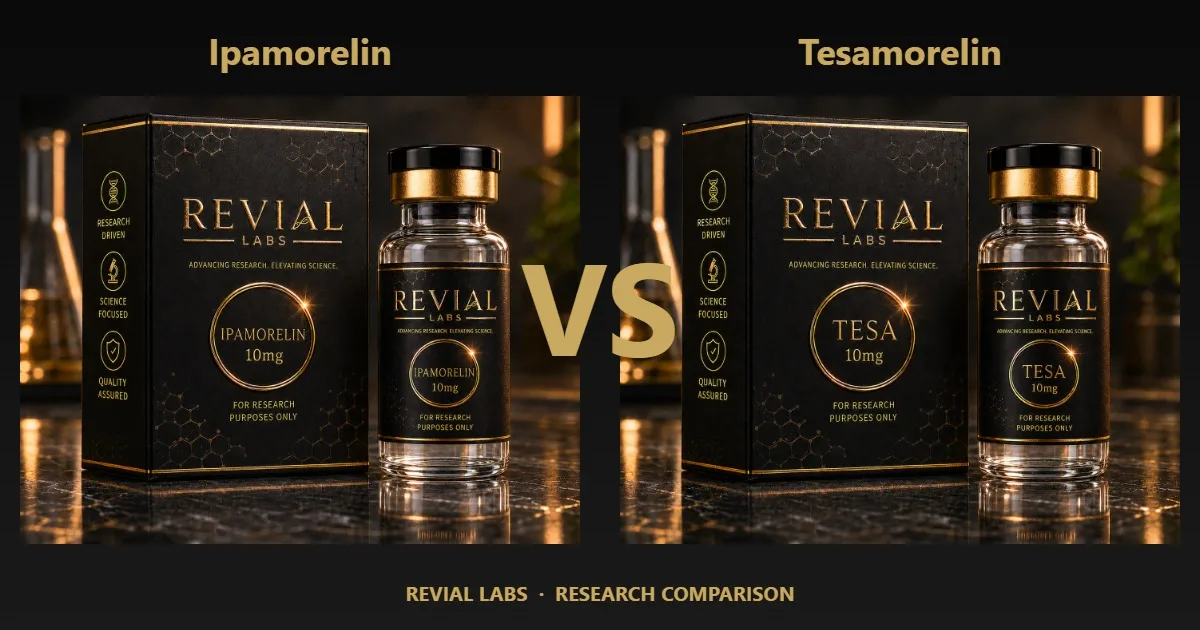
Ipamorelin vs Tesamorelin: A Research Comparison
Ipamorelin and Tesamorelin are two of the most-studied peptides in growth-hormone-axis research, and both are frequently referenced in the same conversations. They are often used together in research protocols because they act on entirely different receptors — Ipamorelin at the ghrelin receptor, Tesamorelin at the growth hormone-releasing hormone (GHRH) receptor — producing effects on growth hormone release that can be additive or synergistic in preclinical models. This comparison walks through the receptors each targets, their research applications, and how they complement each other.
At a Glance
| Property | Ipamorelin | Tesamorelin |
|---|---|---|
| Class | Growth hormone-releasing peptide (GHRP) | GHRH analog |
| Receptor target | Ghrelin receptor (GHSR-1a) | GHRH receptor |
| Structure | Pentapeptide (5 amino acids) | 44-amino-acid peptide |
| Molecular weight | 711.86 g/mol | 5195.90 g/mol |
| CAS number | 170851-70-4 | 218949-48-5 |
| Regulatory status | Not approved by MHRA/FDA | FDA-approved (Egrifta) for HIV-associated lipodystrophy |
The Two Receptor Pathways
Growth hormone is released from the anterior pituitary under the control of two opposing hormonal signals. GHRH (growth hormone-releasing hormone) stimulates its release; somatostatin inhibits it. On top of this GHRH/somatostatin axis, a third signal — ghrelin — also stimulates GH release through its own dedicated receptor (GHSR-1a), which is expressed on the same pituitary somatotroph cells.
Ipamorelin is a growth hormone-releasing peptide (GHRP): a small synthetic pentapeptide that mimics ghrelin at the GHSR-1a receptor. It was engineered in the late 1990s specifically for its selectivity — unlike earlier GHRPs, it activates GHSR-1a without significantly elevating cortisol or prolactin in preclinical studies.
Tesamorelin is a synthetic 44-amino-acid analog of GHRH itself, engineered with an N-terminal trans-3-hexenoic acid modification that increases resistance to enzymatic degradation. It acts directly on the GHRH receptor, working on the same natural pathway used by endogenous GHRH.
Because the two peptides target different receptors that both drive GH release, combining them in research protocols has been reported to produce additive or synergistic effects on GH secretion in preclinical models — a fact that has made the pairing a common feature of GH-axis research.
Areas of Research Investigation Compared
Ipamorelin
- Growth hormone axis studies — GHSR-1a receptor activation and downstream pituitary signalling
- Ghrelin receptor pharmacology — selective GHRP action without cortisol or prolactin elevation
- Bone density models — trabecular bone parameters in growth-hormone-dependent contexts
- Gastrointestinal motility research — ghrelin-receptor-mediated effects on gastric emptying
Tesamorelin
- GHRH receptor pharmacology — receptor binding, cAMP signalling, somatotroph activity
- Visceral adipose tissue models — GH-mediated lipolysis in visceral fat
- IGF-1 axis studies — downstream effects on insulin-like growth factor 1 signalling
- Cognitive research — GHRH pathway activity in age-related cognitive decline models
The two peptides overlap in the “big picture” of GH-axis research — both are used to stimulate endogenous GH release for downstream study — but their specific literatures diverge. Ipamorelin’s research is more focused on receptor selectivity and ghrelin-family pharmacology; Tesamorelin’s is more focused on downstream tissue effects like visceral adiposity and IGF-1.
Key Differences
1. Receptor target
This is the fundamental difference. Ipamorelin acts on the ghrelin receptor (GHSR-1a); Tesamorelin acts on the GHRH receptor. Both drive GH release, but through independent pathways.
2. Size and structure
Ipamorelin is a tiny pentapeptide (5 amino acids, 711.86 g/mol). Tesamorelin is nearly ten times larger (44 amino acids, 5195.90 g/mol). This has practical implications: Ipamorelin is cheaper to synthesise, easier to formulate, and generally has different pharmacokinetic behaviour than the much larger Tesamorelin.
3. Regulatory status
Tesamorelin has FDA approval for a specific clinical indication — HIV-associated lipodystrophy — marketed as Egrifta. Ipamorelin is not approved by the MHRA, FDA, or any equivalent regulator for human use. In a research context, both are supplied strictly for laboratory research use only.
4. Research heritage
Ipamorelin’s literature is dominated by GHRP-family comparisons and receptor selectivity studies. Tesamorelin’s literature is broader across pituitary and adipose-tissue research, and includes clinical trial data due to its approval status.
Where They Overlap
The overlap is in the “GH release” step of the GH axis. Both compounds are commonly used in preclinical models where the researcher wants to stimulate endogenous GH release and study downstream effects. Because the two receptors are independent, combining a GHRP with a GHRH analog is a standard research strategy for producing a larger GH pulse than either alone. Combination studies of GHRPs with GHRH analogs have been reported since the 1990s.
Product Specifications Compared
| Specification | Ipamorelin | Tesamorelin |
|---|---|---|
| Molecular formula | C₃₈H₄₉N₉O₅ | C₂₂₁H₃₆₆N₇₂O₆₇S |
| Molecular weight | 711.86 g/mol | 5195.90 g/mol |
| Structure | Aib-His-D-2Nal-D-Phe-Lys-NH₂ | 44-aa GHRH analog, hexenoic acid N-terminal |
| Recommended solvent | Bacteriostatic water | Bacteriostatic water |
| Vial size (Revial Labs) | 10mg | 10mg |
| Purity | ≥99% HPLC verified | ≥99% HPLC verified |
Choosing Between Them in a Research Context
- Ghrelin receptor pharmacology or GHRP-family research — Ipamorelin is the standard tool.
- GHRH pathway research or visceral adipose tissue models — Tesamorelin has the deeper literature.
- Studying additive or synergistic GH release from combining both pathways — the two peptides together are the natural experimental design.
- Research where regulatory-approved reference compounds matter — Tesamorelin has FDA approval for a specific indication, which some research contexts require.
Frequently Asked Questions
Are Ipamorelin and Tesamorelin interchangeable?
No. They act on different receptors and are appropriate for different research questions. Both drive GH release, but the mechanism, size, pharmacokinetics, and downstream research applications differ substantially.
Why combine a GHRP with a GHRH analog?
Because they act on independent pathways that both drive GH release, combining a GHRP (like Ipamorelin) with a GHRH analog (like Tesamorelin) can produce a larger GH pulse than either compound alone. This combination approach has been documented in preclinical research since the 1990s.
Which came first, GHRPs or GHRH analogs?
GHRH was isolated first (early 1980s), and Tesamorelin was developed as a stabilised GHRH analog. GHRPs including the direct predecessors of Ipamorelin were also developed in the 1980s but as an initially separate line of research; the ghrelin receptor was not identified as their target until the 1990s.
Do both peptides use bacteriostatic water for reconstitution?
Yes. Both are typically reconstituted in bacteriostatic water. See How to Reconstitute Research Peptides for step-by-step guidance.
Products Referenced in This Comparison
Further Reading
Research Use Only
All products referenced in this article are supplied by Revial Labs for in vitro laboratory research use only. Not for human or veterinary use, not for use in food, cosmetics, or supplements, and not for diagnostic or therapeutic purposes. This article is a summary of published research directions and should not be interpreted as claims about either compound’s effects in humans.
Compounds referenced in this article
Revial Labs supplies the following research compounds discussed above, each independently COA tested and dispatched from the UK for laboratory research use only:
You can calculate reconstitution volumes with our free Peptide Reconstitution Calculator.