MT2 (Melanotan II): What It Is and What It’s Known For
MT2 — formally Melanotan II — is a non-selective melanocortin receptor agonist with a broad research profile spanning pigmentation, appetite regulation, and libido biology. Here is what it is and what to look for when sourcing it.
What is MT2?
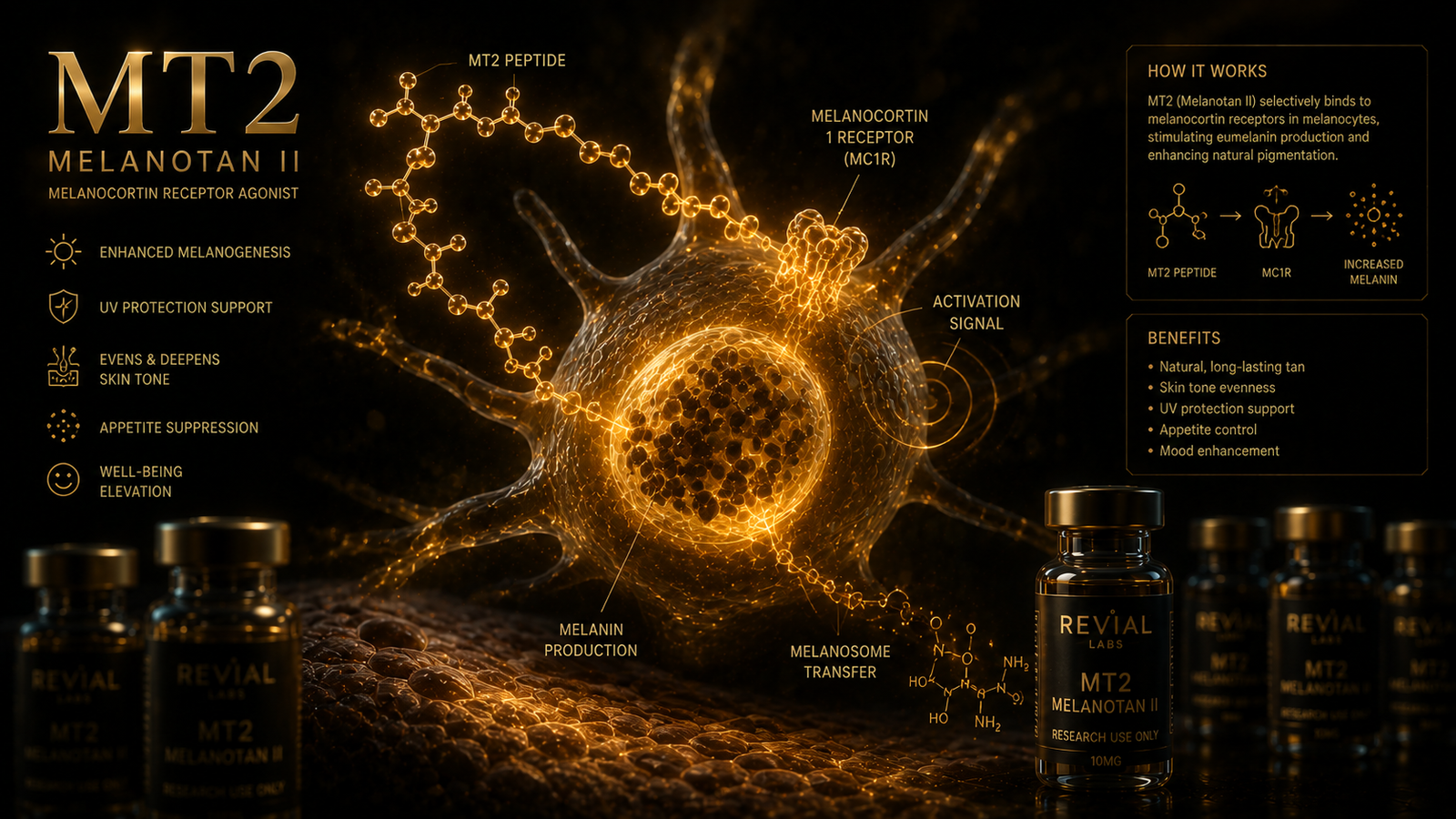
MT2 (Melanotan II) is a synthetic analogue of alpha-melanocyte-stimulating hormone (α-MSH), a naturally occurring peptide derived from pro-opiomelanocortin (POMC). It is a cyclic heptapeptide — seven amino acids arranged in a ring structure — designed to be more potent and metabolically stable than endogenous α-MSH. It acts as a non-selective agonist across the melanocortin receptor family (MC1R through MC5R). It is supplied as a lyophilised powder for research reconstitution.
What is it known for?
MT2 is known for three distinct research areas, each tied to a different melanocortin receptor subtype.
Melanogenesis (MC1R)
MC1R is expressed in melanocytes and governs melanin production. MT2 activation of MC1R stimulates melanogenesis — the synthesis of eumelanin (dark pigment) — independently of UV radiation, though UV exposure amplifies the response in relevant models. This is the most widely studied aspect of MT2 in dermatology and pigmentation research.
Appetite Regulation (MC3R/MC4R)
MC3R and MC4R are expressed in the hypothalamus and play central roles in energy balance regulation. MC4R in particular is the most studied receptor in obesity biology: germline loss-of-function mutations in MC4R are the most common monogenic cause of human obesity. MT2’s activity at these receptors places it in the appetite and energy homeostasis research space.
Libido Research (MC4R)
MC4R activity in the central nervous system is also associated with sexual function research. MT2 has been studied in models of arousal and erectile function, where its melanocortin effects on spinal and supraspinal pathways have been documented in preclinical research.
Non-Selectivity as a Research Variable
The non-selective receptor profile of MT2 is important context for research design: it activates all five MC receptors, which means effects observed in research models may reflect combined receptor activity rather than a single pathway. Researchers studying a specific melanocortin axis need to account for this when designing protocols and interpreting results.
Properties Researchers Value
- Multi-receptor melanocortin activity — simultaneous MC1–5R engagement makes it useful for broad melanocortin pathway research.
- α-MSH structural basis — well-characterised parent compound with an extensive preclinical literature.
- Cyclic structure — the ring architecture improves metabolic stability relative to linear analogues.
- Reconstitution — dissolves in bacteriostatic water; photosensitivity means storage in amber vials is recommended.
What to Look for When Sourcing
Independent COA with HPLC purity and mass spectrometry identity from a named laboratory. The cyclic structure of MT2 can be confirmed by mass spectrometry against its expected molecular weight (MW ~1024 Da). See our guide on why COA testing matters.
Reconstitution
MT2 is supplied lyophilised and dissolved in bacteriostatic water. Store away from light after reconstitution. Our reconstitution guide covers technique and storage best practices. Use the Peptide Calculator for volume calculations.
Our Approach
At Revial Labs, our MT2 10mg is independently COA tested so researchers can verify identity and purity before use. Every compound we supply is intended strictly for laboratory research.
Compounds Referenced in This Article
This article is provided for educational purposes for laboratory research professionals. All Revial Labs compounds are supplied strictly for laboratory research use only and are not for human or veterinary use.