
GLP-1 Peptides and Longevity: What the Epigenetic Research Shows
The research story around GLP-1 class peptides is expanding well beyond glycaemic control and weight. Here is a summary of what current studies suggest about GLP-1 activity and biological ageing — positioned strictly within a research and laboratory context.
Beyond Metabolic Biology
GLP-1 receptor agonists — including semaglutide, tirzepatide, and retatrutide — have been the focus of intense metabolic research for over a decade. What has shifted in 2025–2026 is the emergence of research examining whether these compounds influence biological ageing directly, independent of their metabolic effects.
Epigenetic Clock Studies
In 2025, researchers at UC San Diego published the first randomised, placebo-controlled evidence that semaglutide reduces biological age as measured by validated epigenetic clocks. Epigenetic clocks (including Horvath, GrimAge, and DunedinPACE) estimate biological age from DNA methylation patterns and are considered among the most sensitive biomarkers of ageing currently available.
The study reported statistically significant reductions in GrimAge and DunedinPACE scores in participants receiving semaglutide over 12 months — reductions not fully explained by weight loss alone, suggesting GLP-1 receptor signalling may have direct epigenetic effects.
The SURMOUNT-MMO Trial
SURMOUNT-MMO is a tirzepatide trial with an unusual primary endpoint: all-cause mortality and major adverse cardiovascular events (MACE) in adults with obesity but without diabetes. It is one of the first GLP-1 class trials to place longevity — rather than a surrogate metabolic marker — at the centre of its endpoint structure. Results are expected in 2027–2028.
The trial design reflects a broader shift in how the research community is thinking about incretin-class compounds: not solely as metabolic interventions, but as potential modulators of the biology underlying age-related disease.
Cardiovascular Research
SELECT (semaglutide, 17,604 participants, non-diabetic cardiovascular disease cohort) reported a 20% reduction in major adverse cardiovascular events. The FLOW trial (semaglutide in chronic kidney disease) showed significant reductions in kidney disease progression and cardiovascular death. Both results broadened the research framing of GLP-1 compounds beyond metabolic outcomes.
Anti-Inflammatory Mechanisms
A candidate mechanism for the longevity-adjacent effects is the anti-inflammatory activity attributed to GLP-1 receptor signalling. GLP-1 receptors are expressed in immune and vascular tissues, and preclinical studies have documented reductions in inflammatory markers — including CRP and IL-6 — in GLP-1 agonist models. Chronic low-grade inflammation is a central mechanism in theories of biological ageing (inflammageing), making this a plausible research axis.
The Glucagon Layer: Retatrutide
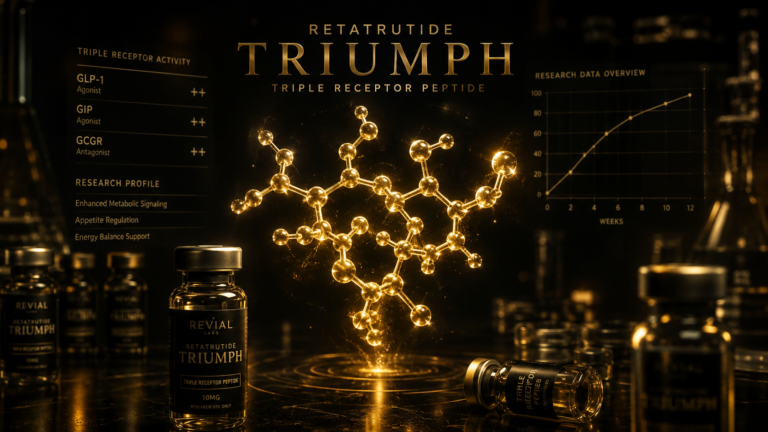
For researchers studying triple agonism, the addition of glucagon receptor activity in retatrutide adds another variable to the longevity research question. Glucagon has independent roles in hepatic lipid metabolism and energy expenditure — and emerging research is beginning to examine whether glucagon receptor co-activation produces metabolic effects relevant to ageing biology beyond what GLP-1 or GIP activation produces alone.
Where Research Currently Stands
The longevity implications of GLP-1 class peptides remain an active area of investigation. Epigenetic clock data is preliminary, SURMOUNT-MMO is ongoing, and mechanistic studies in this area are still early-stage. The area represents one of the most active frontiers in metabolic research.
For compound-specific research context, see: Retatrutide — What It Is and What It’s Known For and Tirzepatide vs Retatrutide. For the broader longevity research molecule context, see: MOTS-C vs NAD+.
Compounds Referenced in This Article
This article is provided for educational and informational purposes for laboratory research professionals. All Revial Labs compounds are supplied strictly for laboratory research use only and are not for human or veterinary use.