NAD+: What It Is and What It’s Known For
NAD+ is one of the most researched molecules in cellular biology and longevity science. Here is what it is, what makes it distinct from related compounds, and what to look for when sourcing it.
What is NAD+?
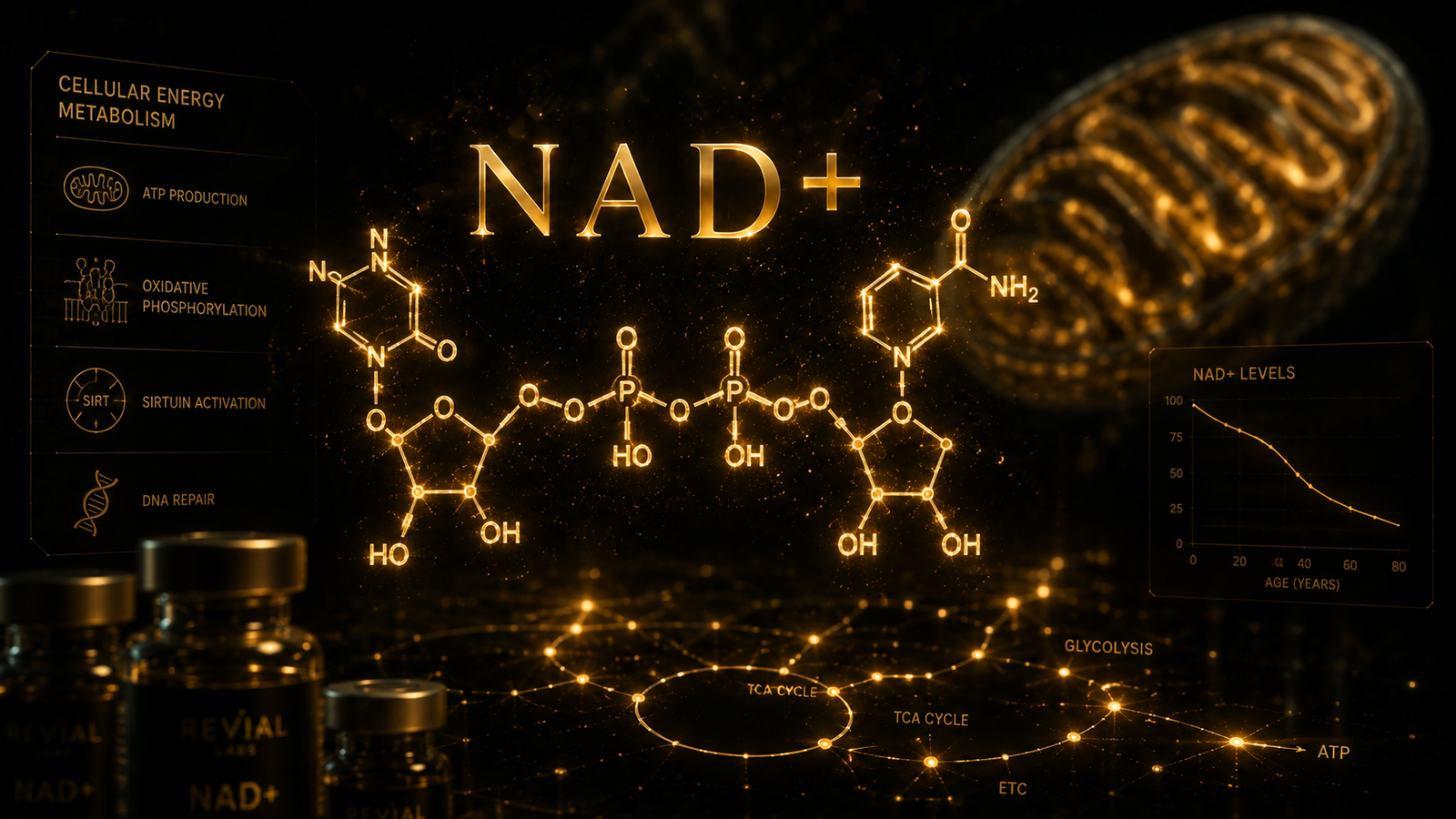
NAD+ (nicotinamide adenine dinucleotide) is a coenzyme present in every living cell. It is not a peptide — it belongs to the class of nucleotide-derived coenzymes — but it occupies the same research space as many longevity-adjacent peptides and is frequently studied alongside compounds like MOTS-C and Ipamorelin. It exists in two forms: NAD+ (oxidised) and NADH (reduced), cycling between the two as it carries electrons in metabolic reactions. For research purposes it is supplied as a lyophilised powder, typically as its sodium salt.
What is it known for?
NAD+ is central to two major areas of current research: cellular energy metabolism and sirtuin-mediated longevity biology.
Energy Metabolism
NAD+ is a required cofactor in glycolysis, the citric acid cycle, and oxidative phosphorylation. It accepts electrons from metabolic reactions (becoming NADH) and transfers them to the mitochondrial electron transport chain, enabling ATP production. Without adequate NAD+, these fundamental processes cannot proceed.
Sirtuin Activation
Sirtuins (SIRT1–SIRT7) are a family of NAD+-dependent deacetylases linked to gene expression regulation, DNA repair, mitochondrial biogenesis, and inflammation modulation. NAD+ is consumed in the sirtuin reaction, meaning sirtuin activity is directly dependent on intracellular NAD+ availability. SIRT1 and SIRT3 have been the most studied in longevity contexts.
Age-Related NAD+ Decline
Intracellular NAD+ levels decline measurably with age in multiple tissues. This decline has been proposed as a contributing mechanism in metabolic deterioration, reduced mitochondrial function, and impaired DNA repair — making NAD+ repletion a major focus of longevity research.
NAD+ vs NMN vs NR
Researchers frequently encounter three related molecules. NAD+ is the active coenzyme itself — for injectable research applications, direct NAD+ is the most studied form. NMN (nicotinamide mononucleotide) is a biosynthetic precursor to NAD+, converted by the NMNAT enzyme family. NR (nicotinamide riboside) is another precursor, converted to NMN and then to NAD+. The comparative bioavailability and conversion efficiency of these three forms in different tissue types is an active area of investigation.
Properties Researchers Value
- Fundamental coenzyme role — required cofactor in core energy metabolism pathways.
- Sirtuin dependency — direct mechanistic link to the most-studied longevity enzyme family.
- Age-related relevance — declining endogenous levels make it relevant to ageing research models.
- Defined structure — well-characterised by mass spectrometry and HPLC.
What to Look for When Sourcing
NAD+ purity and identity are critical for accurate dosing in research protocols. Look for an independent COA with HPLC purity confirmation and mass spectrometry identity from a named third-party laboratory. See our guide on why COA testing matters.
Reconstitution
NAD+ is supplied lyophilised and dissolved in sterile or bacteriostatic water before use. Our guide on how to reconstitute research peptides applies, with solvent choice covered in bacteriostatic vs acetic acid water. For comparison with MOTS-C in the longevity research space, see MOTS-C vs NAD+. Use the free Peptide Reconstitution Calculator for volume calculations.
Our Approach
At Revial Labs, our NAD+ 500mg is independently COA tested so researchers can verify identity and purity before use. Every compound we supply is intended strictly for laboratory research.
Compounds Referenced in This Article
This article is provided for educational purposes for laboratory research professionals. All Revial Labs compounds are supplied strictly for laboratory research use only and are not for human or veterinary use.