KLOW Blend Explained: KLOW vs GLOW Peptide Blends Compared
KLOW and GLOW are two of the most talked-about multi-peptide blends in the UK research market. The names are almost identical and so are most of the ingredients, which causes a lot of confusion. This guide explains exactly what is in each blend, how they differ, and how to decide which one fits your research.
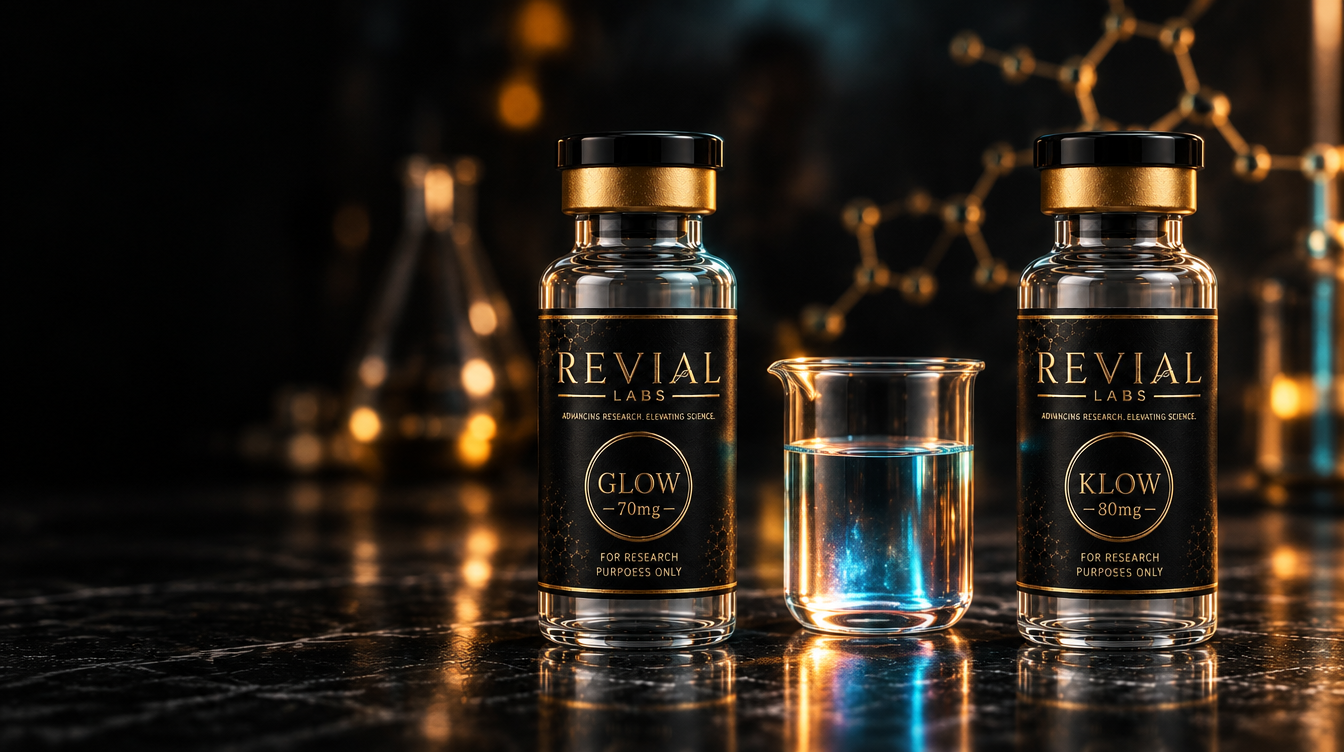
Quick summary: GLOW combines GHK-Cu, BPC-157 and TB-500 (70mg total). KLOW is the same three peptides plus KPV (80mg total). The extra KPV adds an anti-inflammatory research angle to GLOW’s skin and tissue-repair focus. Revial Labs supplies the Glow Stack 70mg at £74.99 and the Klow Blend 80mg at £79.99.
What Is the GLOW Blend?
GLOW is a three-peptide blend built around GHK-Cu, the copper peptide most studied in skin, collagen and hair-follicle research. Two repair-focused peptides, BPC-157 and TB-500, sit alongside it.
- GHK-Cu 50mg – copper tripeptide studied in fibroblast activity, collagen synthesis and dermal repair
- BPC-157 10mg – 15-amino-acid peptide studied in tendon, gut and wound-healing models
- TB-500 10mg – synthetic thymosin beta-4 fragment studied in cell migration and wound healing
Our full guide, GLOW Stack Peptide Explained, covers it in more detail.
What Is the KLOW Blend?
KLOW is GLOW with a fourth peptide added: KPV. KPV is a tripeptide (lysine-proline-valine) taken from the end of alpha-melanocyte-stimulating hormone (α-MSH). It has been studied mainly for its effects on inflammatory signalling, including the NF-κB pathway, in gut and skin models.
- GHK-Cu 50mg
- BPC-157 10mg
- TB-500 10mg
- KPV 10mg
The “K” in KLOW is generally taken to stand for KPV. The idea behind the blend is to combine GLOW’s repair and dermal research profile with an inflammation-focused compound in one vial.
KLOW vs GLOW: Side-by-Side Comparison
| GLOW | KLOW | |
|---|---|---|
| GHK-Cu | 50mg | 50mg |
| BPC-157 | 10mg | 10mg |
| TB-500 | 10mg | 10mg |
| KPV | – | 10mg |
| Total peptide | 70mg | 80mg |
| Research focus | Skin, collagen, tissue repair | Skin and tissue repair plus inflammation models |
| Solution colour | Pale blue (copper) | Pale blue (copper) |
| Revial Labs price | £74.99 | £79.99 |
The Research Behind Each Component
GHK-Cu
GHK-Cu is a naturally occurring copper complex first identified in human plasma. Laboratory research has examined its role in collagen and glycosaminoglycan production, fibroblast behaviour, antioxidant activity and hair-follicle biology. It is the reason both blends turn a pale blue colour when reconstituted. Read more in GHK-Cu: What It Is and What It’s Known For.
BPC-157
BPC-157 has been studied mostly in rodent models of tendon, ligament, gut and wound repair, as well as blood-vessel formation. See our BPC-157 UK research guide.
TB-500
TB-500 is a synthetic version of the active region of thymosin beta-4, a protein involved in actin regulation and cell migration. It is studied in wound-healing and tissue-remodelling models. Read TB-500: What It Is and What It’s Known For and BPC-157 vs TB-500.
KPV
KPV is the C-terminal tripeptide of α-MSH. Research has focused on anti-inflammatory activity in intestinal and skin cell models. For how it compares with BPC-157, see BPC-157 vs KPV.
Which Blend Should You Choose?
The choice depends on the research question, not on which blend is “stronger”:
- Choose GLOW if your work centres on dermal, collagen or tissue-repair models and inflammation is not a variable you want to introduce.
- Choose KLOW if your work also looks at inflammatory signalling, or you want to study the four compounds together.
- Choose individual vials if you need different ratios, want to isolate the effect of each peptide, or plan to vary one compound at a time. You can buy GHK-Cu, BPC-157, TB-500 and KPV separately.
- Choose the Wolverine Blend if you only need BPC-157 and TB-500 without the copper peptide. See the Wolverine Blend 20mg.
Is a Blend Better Value?
Blends save on preparation as well as price. You reconstitute one vial instead of three or four, which means fewer steps, less bacteriostatic water and fewer chances for pipetting errors. The trade-off is that the ratio is fixed. If your protocol calls for a different balance between compounds, separate vials give you that control.
Reconstitution and Storage
Both blends are supplied as lyophilised powder and reconstituted in bacteriostatic water. A pale blue tint is normal because of the copper in GHK-Cu. When using the Peptide Reconstitution Calculator, enter the total blend content (70mg or 80mg).
Store unopened vials at 2–8°C. After reconstitution, keep the solution in the fridge, protect it from light (copper peptides are light-sensitive) and use within about four weeks. See our full guide on how to store peptides.
Related Research Guides
- Wolverine blend (BPC-157 + TB-500) explained
- TB-500 UK research guide
- GHK-Cu UK research guide
- MOTS-c UK research guide
- NAD+ UK research guide
Frequently Asked Questions
What is the KLOW blend?
KLOW is an 80mg research blend of GHK-Cu (50mg), BPC-157 (10mg), TB-500 (10mg) and KPV (10mg) in a single lyophilised vial.
What is the difference between KLOW and GLOW?
KLOW contains everything in GLOW plus 10mg of KPV. GLOW is 70mg in total and KLOW is 80mg.
Where can I buy the GLOW peptide in the UK?
Revial Labs supplies the Glow Stack 70mg for £74.99 from UK stock, with same-day dispatch on weekday orders placed before 2pm.
Why does the solution turn blue?
The blue tint comes from the copper in GHK-Cu. It is expected and does not indicate a problem with the product.
Are KLOW and GLOW approved for human use?
No. None of the component peptides is approved by the MHRA or any equivalent regulator. Both blends are sold for laboratory research only. TB-500 and BPC-157 are also on the WADA prohibited list.
How much is the KLOW blend?
The Revial Labs Klow Blend 80mg is £79.99 per vial, which is less than buying the four peptides separately.
All products supplied by Revial Labs are intended for in vitro laboratory research use only. They are not for human or veterinary use, and nothing in this article is medical advice or a recommendation for use in people or animals.