How to Reconstitute Research Peptides: A Beginner’s Guide
Reconstitution is the process of dissolving a lyophilised (freeze-dried) peptide into a liquid solvent so it can be accurately measured for laboratory research. Getting it right is essential for reliable, repeatable results. This guide covers the fundamentals for research settings.
What is a lyophilised peptide?
Most research peptides are supplied as a lyophilised powder — a stable, freeze-dried form that preserves the compound during storage and transport. Before it can be used in research, the powder must be reconstituted into solution.
Choosing a solvent
The two most common solvents in peptide research are:
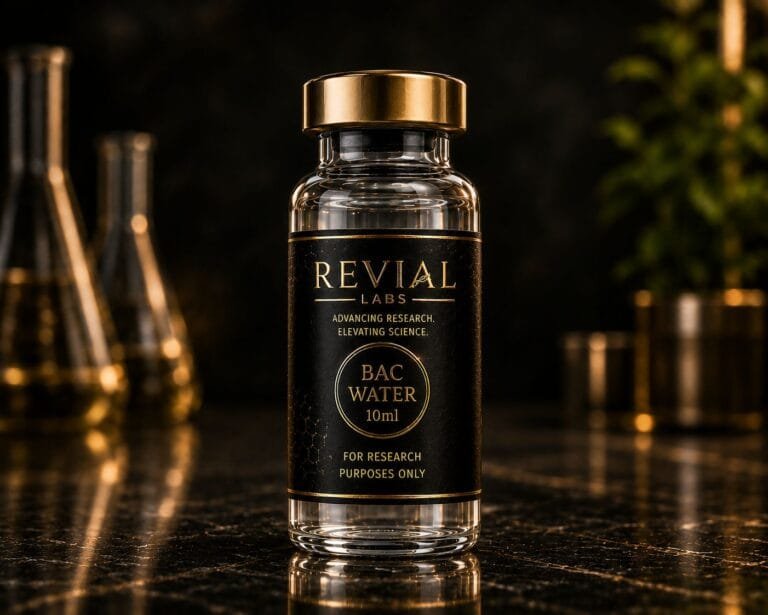
- Bacteriostatic water — sterile water containing 0.9% benzyl alcohol. The bacteriostatic agent inhibits microbial growth, allowing a vial to be used across multiple withdrawals. This is the standard choice for most soluble peptides.
- Acetic acid water — a dilute acetic acid solution used for peptides that are poorly soluble in standard bacteriostatic water, such as certain blends and hydrophobic fragments.
Calculating your concentration
Concentration is simply the amount of peptide divided by the volume of solvent added. For example, a 10 mg vial reconstituted with 2 mL of bacteriostatic water yields a concentration of 5 mg/mL.
To take the maths out of it entirely, our free Peptide Reconstitution Calculator works out your concentration and draw volume automatically — including the correct markings on an insulin syringe.
General reconstitution steps (laboratory)
- Allow both the peptide vial and solvent to reach room temperature.
- Clean both rubber stoppers with an alcohol swab.
- Draw the chosen volume of solvent into a syringe.
- Introduce the solvent slowly, letting it run down the inside wall of the vial rather than directly onto the powder — this protects the fragile peptide structure.
- Do not shake. Gently swirl or leave to stand until fully dissolved.
Storage
Once reconstituted, most peptides should be stored refrigerated and protected from light. Lyophilised (un-reconstituted) vials are considerably more stable and can typically be stored frozen for extended periods. Always refer to compound-specific guidance.
This article is provided for educational purposes for laboratory research professionals. All Revial Labs compounds are supplied strictly for laboratory research use only and are not for human or veterinary use.