Survodutide: What It Is and What It’s Known For
Survodutide is one of the next-generation metabolic peptides drawing significant research attention in 2026 — a GLP-1/glucagon dual receptor agonist with a distinctive focus on liver biology. Here is what it is, what it is known for, and what to look for when sourcing it.
What is Survodutide?
Survodutide (developmental code BI 456906) is a synthetic peptide designed to act as a dual agonist at two receptor targets: the glucagon-like peptide-1 (GLP-1) receptor and the glucagon (GCGR) receptor. It was developed on a peptide platform licensed from Zealand Pharma and is being advanced through clinical research by Boehringer Ingelheim. Structurally it is a long-acting acylated peptide, engineered for once-weekly administration, and is supplied for research as a lyophilised powder for reconstitution before use.
What is it known for?
Survodutide is best known within research circles for its dual GLP-1/glucagon mechanism and, in particular, for the attention its programme has drawn in metabolic dysfunction-associated steatohepatitis (MASH) research — the liver-focused end of the metabolic peptide field. The glucagon arm of its mechanism is of research interest for its hypothesised effects on hepatic lipid metabolism and energy expenditure, which sit alongside the appetite-regulation and glucose-handling effects associated with GLP-1 activity.
In published Phase 2 research, survodutide has been studied in obesity and metabolic models, with the COURAGE study among the most frequently referenced. It is often grouped with Retatrutide and mazdutide as part of the broader move toward glucagon-inclusive multi-agonist research.
The GLP-1/Glucagon Dual Mechanism
Survodutide engages two complementary pathways. The GLP-1 arm is associated with appetite suppression, slowed gastric emptying, and glucose-dependent insulin secretion — the same broad mechanism underpinning single-agonist GLP-1 research. The glucagon (GCGR) arm adds a distinct dimension: glucagon receptor activation is studied for its role in energy expenditure and hepatic fat oxidation. Combining the two in a single molecule is the central research rationale — the idea that glucagon-driven energy expenditure may complement GLP-1-driven appetite reduction.
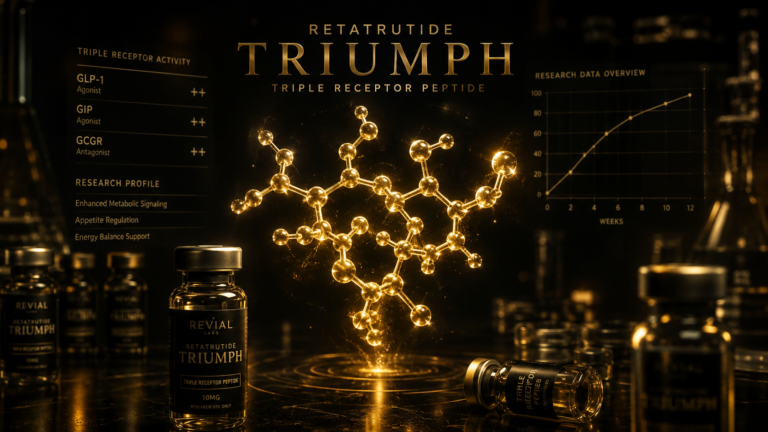
This dual approach is what distinguishes survodutide from single-pathway GLP-1 compounds, and places it in the same conceptual family as mazdutide — another GLP-1/glucagon dual agonist — while remaining distinct from the triple-agonist design of Retatrutide.
How It Compares to Related Compounds
Survodutide’s closest mechanical cousin is mazdutide, which targets the same two receptors. The most-studied difference across the wider group is receptor count: survodutide and mazdutide are dual (GLP-1/glucagon) agonists, while Retatrutide is a triple agonist that adds GIP receptor activity. It is worth noting that no published head-to-head trials exist between these compounds as of 2026, so any cross-compound comparison is indirect and drawn from separate studies with different populations and designs.
Properties Researchers Value
- Dual-pathway mechanism — engages both GLP-1 and glucagon receptors, a key area of current metabolic research.
- Long-acting design — acylated structure engineered for extended half-life and once-weekly research protocols.
- Liver-research relevance — frequently referenced in MASH and hepatic lipid metabolism models.
- Reconstitution — supplied lyophilised and dissolves readily in bacteriostatic water.
What to Look for When Sourcing
As a long, acylated peptide, survodutide is more complex to synthesise than shorter sequences, which makes purity verification important. Look for an independent Certificate of Analysis confirming HPLC purity (≥98%) and mass spectrometry identity from a named third-party laboratory. Our guide on why COA testing matters explains what to check and why it matters for research validity.
Reconstitution
Survodutide is supplied lyophilised and dissolved in bacteriostatic water before use. Our reconstitution guide covers the full process, and the Peptide Calculator handles concentration and draw-volume calculations.
Where It Sits in the Research Landscape
Survodutide is part of a wider 2026 shift in metabolic peptide research — away from single-pathway GLP-1 biology and toward multi-receptor strategies. For the broader picture, see our overview of triple agonists as the next frontier after dual agonists, and our comparison of Tirzepatide vs Retatrutide.
Compounds Referenced in This Article
This article is provided for educational purposes for laboratory research professionals. Survodutide is an investigational compound and is not approved by the MHRA, FDA, or any equivalent regulatory body. All Revial Labs compounds are supplied strictly for laboratory research use only and are not for human or veterinary use.